Get the choice wrong and you end up with a logo that looks muddy on a hat, or a photo-realistic graphic that costs three times what it should. This decision matters for businesses ordering staff uniforms, schools ordering spirit wear, nonprofits planning event shirts, and anyone working against a hard deadline.
This guide breaks down production method, cost drivers, artwork limitations, fabric compatibility, order size, durability, and where each method actually shines.
Key Takeaways
- Embroidery stitches thread into fabric for a raised, textured finish; screen printing applies ink through a mesh screen for a flat, graphic finish.
- Polos, caps, jackets, and uniforms lean toward embroidery; T-shirts, hoodies, and large event runs lean toward screen printing.
- Embroidery pricing hinges on stitch count and digitizing; screen printing pricing hinges on color count, setup, and quantity.
- Your artwork, garment, order size, and deadline decide the winner—there's no universal answer.
Embroidery vs Screen Printing: Quick Comparison
Cost
Embroidery quotes are shaped by several moving parts:
- Stitch count — denser designs take longer to sew and cost more
- Digitizing — converting artwork into a machine-readable stitch file
- Design size and placement — larger designs and multiple locations add time
- Garment type — thicker or specialty fabrics may need extra stabilizing
Screen printing works on a different cost structure:
- Screen setup — each color needs its own screen
- Number of colors — more colors mean more screens and more labor
- Print size and garment type — larger prints and premium blanks cost more
- Order quantity — setup costs spread across more pieces on bigger runs
Affordable Printing quotes both methods per project rather than off a flat rate card, since garment choice, design complexity, and order size all shift the final number. Custom branded apparel orders typically start at a 12-item minimum per design.
Appearance and Texture
Embroidery produces a raised, dimensional finish. Thread catches light differently by stitch direction, so logos feel tactile and premium up close.
Screen printing lays down a flat or lightly textured layer of ink. That flatness is actually an advantage for bold graphics, since it lets colors sit crisp and even across large print areas without the bulk of stitching.
Durability and Care
Both methods hold up well when done right, but they age differently.
Properly digitized embroidery with quality thread resists fading through repeated industrial washing. Screen-printed ink needs proper curing at the right time and temperature. An under-cured print can crack or wash out early, even if it looks fine on day one.
Garment quality, wash habits, and how often the piece gets worn matter just as much as the decoration method itself. A cheap blank with premium embroidery still won't outlast a quality blank with a properly cured print.

Design Complexity and Color
Embroidery works best with clean, bold shapes and readable lettering. Tiny text, fine gradients, or photographic detail tend to distort once stitched, because thread simply can't render the same resolution as ink.
Screen printing handles far more visual complexity. Spot-color printing suits solid logos and text, while halftone techniques translate tonal shading into tiny printable dots, letting shops reproduce gradients and photo-realistic detail that embroidery can't touch.
Garment and Order Suitability
| Method | Best-fit garments | Best-fit order pattern |
|---|---|---|
| Embroidery | Polos, caps, bags, jackets, uniforms | Smaller, recurring staff or team orders |
| Screen printing | T-shirts, hoodies, sweatshirts, event tees | Larger runs with one consistent design |
What Are Embroidery and Screen Printing?
Embroidery: The Basics
Embroidery decorates a garment by sewing thread into the material according to a digitized design file. Production starts with digitizing: converting artwork into stitch-by-stitch machine instructions.
From there, the shop selects the right stabilizer, hoops the garment so it won’t shift, and runs it on a multi-needle machine. Hooping specifically helps prevent fabric movement and puckering during stitching.
A few common variations:
- Flat embroidery — the standard, direct-stitch approach for logos and lettering
- 3D puff embroidery — foam under the stitches creates raised texture, popular on caps
- Embroidered patches — sewn separately, then applied to the garment
Done well, embroidery gives you a raised, professional look that's ideal for logos and holds up under regular washing. The trade-off: extremely fine text, dense gradients, or oversized photographic designs usually need a redesign to translate cleanly into stitches.
Where Embroidery Works Best
Embroidery is the go-to for:
- Left-chest company logos
- Trade and field-service uniforms
- Healthcare and restaurant staff apparel
- School polos, caps, and premium promotional bags
It's a natural fit when the same crew, clinic, or office team needs to look sharp week after week.
Affordable Printing has produced embroidered caps for companies like Terracon and embroidered polos for ThermoWorks. Both are logos that need to read clearly at a glance and survive daily wear.
Screen Printing: The Basics
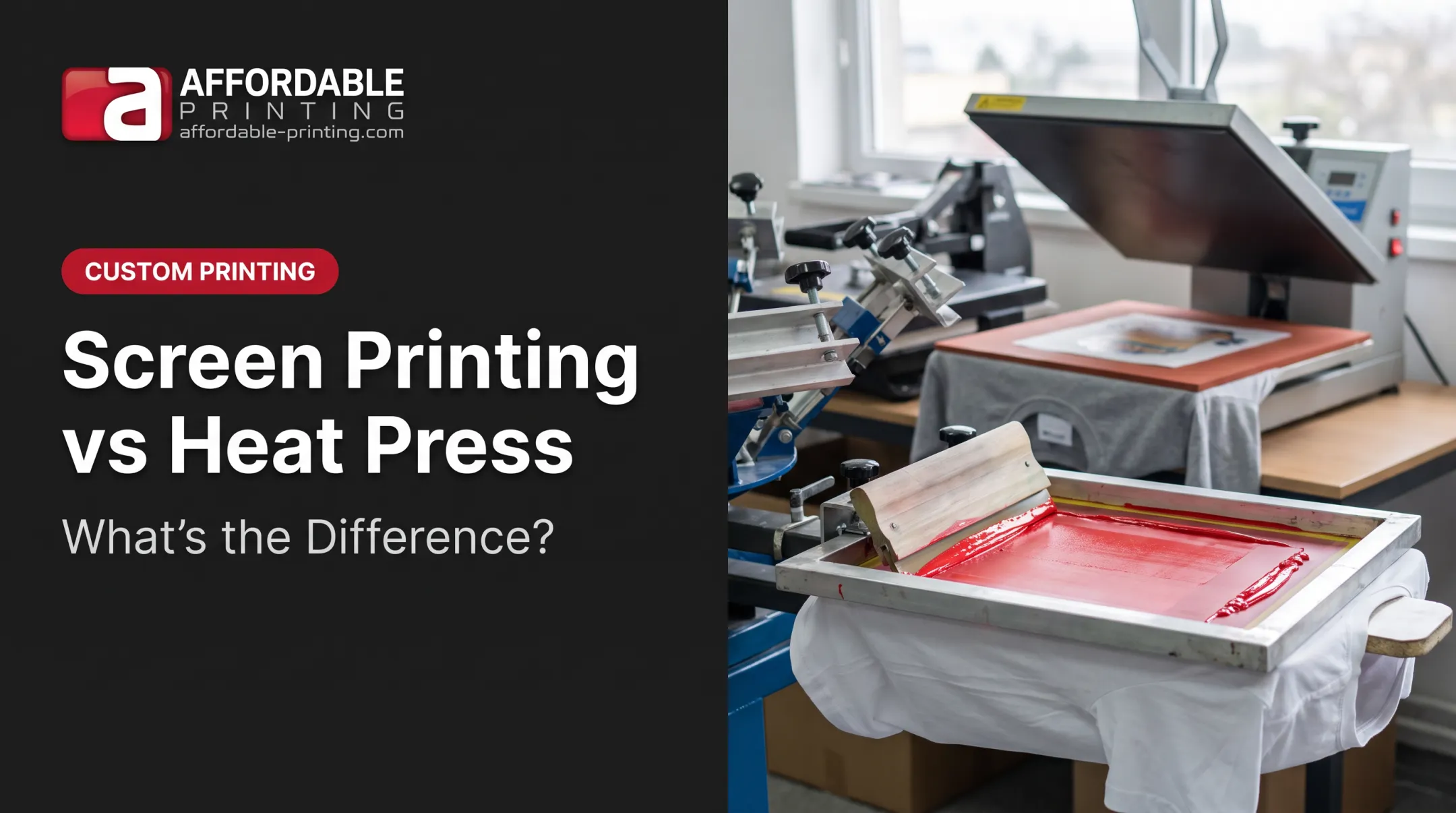
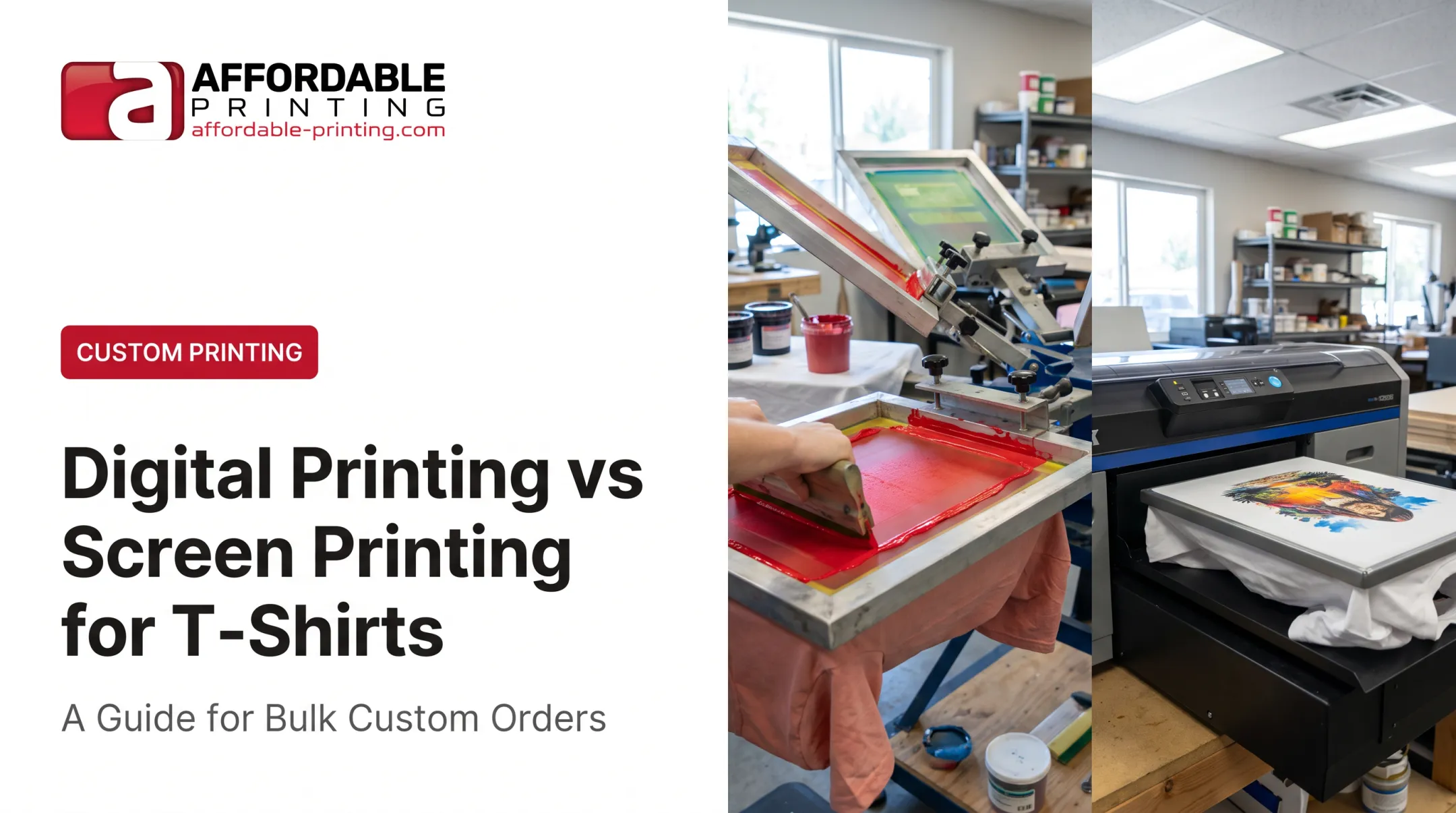
Screen printing transfers ink through a prepared mesh screen and stencil onto a garment. A separate screen is typically required for each color.
The workflow covers color separation, screen prep and exposure, garment positioning, ink application, and curing. Shops usually flash-dry between colors, then heat-cure at the end to lock the ink in.
Screen printing’s strength is impact: saturated color, large print areas, and bold graphics or detailed illustrations across many garment types. The catch is setup. Every extra color adds a screen and a production step, so price climbs with color count. Highly stretchy or heavily textured fabrics can also be harder to print cleanly.

Where Screen Printing Works Best
Screen printing fits team shirts, school spirit wear, charity and community event apparel, family reunion shirts, and promotional campaigns. It works best when the same bold design needs to land on a large batch of identical garments.
Affordable Printing produced screen-printed event shirts for Castle of Chaos, a clear example of the bold, high-visibility graphics this method handles well.
Embroidery vs Screen Printing: What's the Better Choice?
The right method comes down to six factors: artwork, garment, placement, quantity, expected use and washing, and budget or deadline.
Choose Embroidery When...
- Your logo is a compact, readable mark on a polo, hat, jacket, or bag
- The apparel gets worn and washed repeatedly (uniforms, workwear)
- You want a premium, tactile finish over a flat graphic
- A simpler design (fewer tiny details) is workable
Choose Screen Printing When...
- Your artwork is large, colorful, or highly detailed
- You're printing T-shirts, hoodies, or event apparel
- Gradients or multicolor illustrations are part of the design
- You're ordering enough pieces to offset the setup cost
Quantity, Cost, and the Hybrid Option
Cost and quantity usually break this way:
- Screen printing: More economical as quantity climbs, because setup spreads across more garments
- Embroidery: Often smarter for smaller logo runs, with no screen setup to amortize
- Best check: Compare complete quotes, not per-piece guesses
You also don't have to pick only one method. A hybrid order (embroidered logo on the left chest or cap, screen-printed graphic on the back) works when the garment, artwork, and budget support both.
Before you order, gather:
- Final artwork files
- Garment type and color
- Decoration location(s)
- Piece count and size breakdown
- Delivery date
- Wear environment (office, job site, wash frequency)
- Whether you need design help
Affordable Printing helps you compare embroidery, screen printing, and other decoration options, including design support, so the method matches your artwork, quantity, and deadline.
Real-World Examples
A field-service company outfitting crews. A local plumbing or HVAC company needs polos and hats with a compact logo that survives daily job-site wear and industrial laundering. Embroidery holds up better here than a flat print would on heavy-use workwear. Decision cue: choose embroidery for a compact, durable uniform logo.
A school booster club ordering spirit wear. A rivalry-game shirt needs a bold, colorful design across 150+ identical T-shirts on a tight timeline. Screen printing spreads the setup cost across the run and delivers the graphic punch spirit wear needs. Decision cue: choose screen printing when one design needs to appear on a large batch of shirts.
A nonprofit running a fixed-date fundraiser. Event shirts need one bold graphic, a large batch, and a hard deadline. Screen printing fits that brief: Axelrad Screen Printing's "Shirt Off Our Backs" campaign raised $87,550 for 285 local businesses in 57 days. Decision cue: choose screen printing for a large event graphic on a fixed deadline.

Working through a project like one of these? Share your artwork, garment preference, quantity, and deadline with Affordable Printing for a tailored recommendation. The team has served more than 1,000,000 customers with a 99.7% satisfaction rate.
Conclusion
Embroidery generally wins for raised, professional logos and durable uniform branding. Screen printing is usually the stronger choice for colorful, detailed graphics on larger apparel runs.
Neither method is universally better. Match the process to your full project brief:
- Artwork complexity and color count
- Fabric, placement, and expected wear
- Order quantity, budget, and deadline
Before placing a large order, request samples or talk through your project with Affordable Printing. A quick review of artwork, fabric, and quantity is the fastest way to avoid a costly reprint.
Frequently Asked Questions
What is the cost difference between embroidery and screen printing?
Embroidery pricing is driven mainly by stitch count and digitizing fees. Screen printing pricing depends on setup, color count, print size, garment, and quantity. Affordable Printing quotes both after reviewing your artwork and order details.
How much does screen printing usually cost?
Screen printing prices shift based on garment choice, quantity, design size, number of colors, and turnaround time. Request a project-specific quote instead of relying on a general estimate.
What is the average cost for embroidery?
Embroidery pricing varies by stitch count, design dimensions, garment, placement, digitizing, and order quantity. A quote on your actual design and garment beats any industry-wide average.
Which is better, embroidery or screen printing?
Embroidery suits professional logos on polos, hats, and uniforms. Screen printing fits bold, detailed graphics on T-shirts, hoodies, and event apparel. Match the method to your garment and design goals.
Is embroidery more durable than screen printing?
Stitched thread and cured ink both hold up well when produced correctly. Garment quality, wash habits, and abrasion usually affect lifespan more than the decoration method. Neither finish has a universal durability edge.
What are the three main types of screen printing?
The three common types are spot color (solid inks for logos and text), four-color process or CMYK (four inks for full-color images), and simulated process (selected colors and halftones that mimic photographic artwork).