Introduction
Picking a printing method for custom apparel isn't just a technical decision. Choose the wrong one, and you feel it in your budget, your timeline, and how the final product looks and feels on the garment.
DTF (direct-to-film) and screen printing can both produce professional, durable results, but they're built for different jobs. One handles small batches and photo-realistic detail with ease. The other becomes more cost-efficient as quantities climb.
According to the State of the Decorated Apparel Industry Report, a 2025 survey of 73 decorated-apparel companies found average first-quarter sales grew 0.9% year over year. Of those shops, 40.8% reported growth. Demand for custom decoration isn't slowing down, and businesses, schools, and event organizers need to know which method fits their project.
This guide breaks down setup, cost, durability, feel, and fabric compatibility, so you can match the right process to your order.
Key Takeaways
- Pick DTF for small runs, full-color or photo-style art, personalization, and mixed fabrics.
- Screen printing is stronger on large orders, bold simple designs, and repeat runs.
- DTF usually means lower setup cost; screen printing wins on per-item price at volume.
- Neither method is universally better. Choose by quantity, artwork, fabric, and deadline.
DTF vs Screen Printing: Quick Comparison
The core difference comes down to setup. DTF prints your artwork digitally onto film, then transfers it with heat—no screens required.
Screen printing requires burning a separate screen for every color in the design, plus press registration before the first shirt even gets printed.
That single difference drives almost every other trade-off between the two methods.
Cost
DTF skips the screen-making step entirely, which is why it's often practical for one-off shirts and small batches. You're still paying for film, ink, adhesive powder, and the transfer itself, but there's no upfront tooling charge tied to color count.

Screen printing flips that equation. Screen preparation adds real cost before production even starts. But once screens are burned, ScreenPrinting.com notes that screen printing becomes faster and more cost-effective for larger runs with a few colors, since that setup cost gets spread across more shirts.
There's no fixed crossover quantity where one method automatically wins. Get quotes for your actual artwork, garment, and quantity before assuming which is cheaper.
Design Complexity and Color
- DTF handles gradients, photographs, shading, and unlimited colors in a single pass. No extra setup for a five-color design versus a two-color one.
- Screen printing shines with bold, limited-color graphics. Each additional color means another screen, another registration step, and more production time.
If your logo has 12 colors and subtle shading, DTF avoids the headache. If it's a two-color mascot, screens are simple and fast.
Durability and Wash Performance
Both methods can hold up well when done correctly, and both can fail when they aren't.
Ninja Transfers, a DTF supplier, reported over 100 wash-and-dry cycles with retained color, flexibility, and adhesion when garments were hung dry. That's a manufacturer-specific result, not a lab comparison against screen printing.
On the screen-printing side, industry guidance points to full ink cure as the real durability factor. Under-cured plastisol ink cracks and fades regardless of how good the artwork was. Neither method has a documented, head-to-head durability edge in current published testing. Application quality matters more than the process itself.
Print Feel and Appearance
DTF sits on top of the fabric as a thin, smooth layer. Large solid-color designs can feel slightly more present on the shirt, depending on ink coverage and press settings.
Screen printing's feel depends heavily on ink type:
- Plastisol ink creates the classic raised, opaque print most people associate with screen printing.
- Water-based ink soaks into the fibers as it cures, producing a noticeably softer hand.
Neither is objectively softer across the board. Request a sample on your actual garment if feel matters to your project.
Fabric Compatibility and Production Speed
DTF works across cotton, polyester, blends, fleece, and most approved textiles, light or dark. Specialty performance fabrics still deserve a quick compatibility check before a full run.
Screen printing covers a similarly broad range but sometimes needs fabric-specific ink. Polyester, for example, can cause dye migration that bleeds through light-colored ink unless a low-bleed formula is used.
Once screens are set, production moves quickly. Getting to that point just takes longer than DTF's file-to-film workflow.
What Are DTF and Screen Printing?
DTF Printing
Direct-to-film printing is a digital process. Artwork is printed onto specialized film, coated with adhesive powder, cured, and heat-pressed onto the garment.
The typical workflow:
- Artwork prep: files are reviewed for resolution and color accuracy.
- Film printing: the design, including white ink for dark garments, prints onto transfer film.
- Powder application: adhesive powder is applied and excess is removed.
- Curing: the powdered film is heated to activate the adhesive.
- Heat pressing: the transfer is pressed onto the garment under controlled heat and pressure, then peeled and finished.

Main benefits:
- Full-color reproduction without screen separations
- Small-batch flexibility and easy personalization (names, numbers, variations)
- Compatibility with a wide range of fabric types
Limitations to know:
- Print sits on the fabric surface, so poor application can cause edge lifting or peeling
- Results depend on calibrated equipment, correct powder curing, and proper press temperature
- Consumable costs (film, ink, powder) factor into per-unit pricing
Best fits for DTF:
- One-off garments and short runs
- Family reunion shirts with varied sizes
- Small business merchandise testing a new design
- Event graphics with photo-level detail
- Personalized names or numbers on team apparel
- Designs that change frequently between orders
A startup testing a new merch line, a nonprofit ordering shirts for a one-time fundraiser, or a sports team needing different names on the back of each jersey are all classic DTF scenarios.
Screen Printing
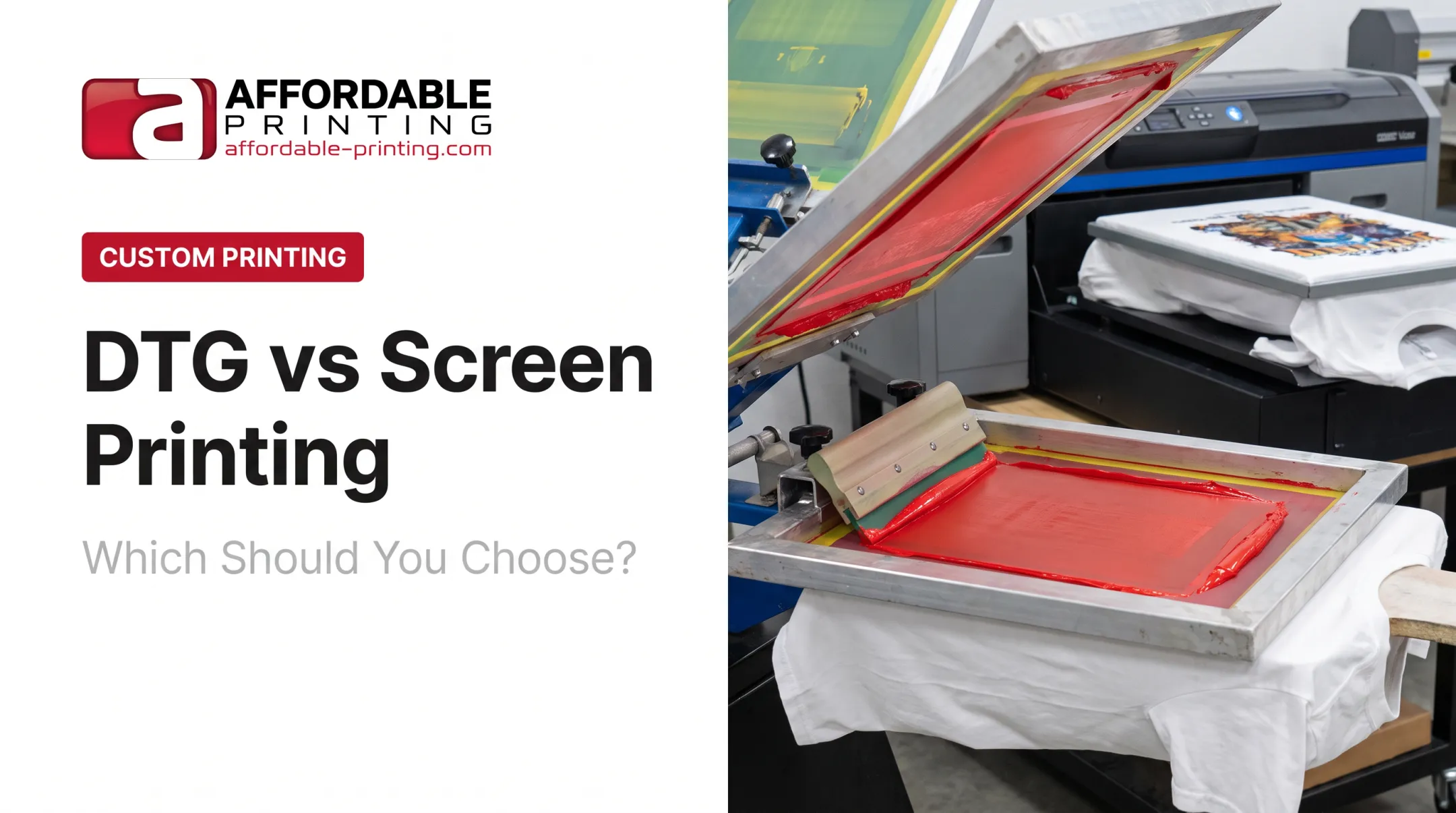
Screen printing is a stencil-based process. Ink gets pushed through a mesh screen onto the garment, with a separate screen typically required for each color.
The workflow:
- Screen prep: emulsion is applied, exposed with the design, and washed out to create a stencil.
- Color separation: multi-color artwork is split into individual screens.
- Registration: screens are aligned on the press for accurate color placement.
- Ink application: ink is pushed through each screen in sequence, with flash curing between colors when needed.
- Final cure and inspection: the finished print is fully cured and checked for quality.
Main benefits:
- Efficient repeat production once screens exist
- Bold ink opacity and the classic apparel look
- Strong cost efficiency at higher volumes
Limitations to know:
- Setup time adds cost before the first shirt prints
- More colors mean more screens and more complexity
- Highly detailed or frequently changing artwork loses efficiency fast, since each variation needs new screens
Best fits for screen printing:
- Team uniforms and school spirit wear
- Staff apparel with a consistent logo
- Event merchandise ordered in bulk
- Branded work shirts for trade and field-service crews
Plumbing, HVAC, electrical, landscaping, and construction companies outfitting crews with matching logo wear are a natural match here. So are restaurants, retail storefronts, and community organizations ordering coordinated staff or volunteer shirts.
A quick note on DTG: Direct-to-garment (DTG) prints ink straight onto the garment inside the printer, with no film transfer step. It suits detailed, smaller orders much like DTF. Screen printing still leads for bold, high-volume, repeatable designs.
DTF vs Screen Printing: What Is Better?
Neither method wins outright. The right answer depends on a handful of factors working together:
- Order quantity and likelihood of reorders
- Artwork complexity and color count
- Garment fabric and desired hand feel
- Durability expectations
- Turnaround needs
- Budget
Choose DTF when:
- The order is small or a one-off
- Artwork is photographic, gradient-heavy, or complex
- Personalization is required per garment
- Designs vary frequently between orders
Choose screen printing when:
- The order is large
- Artwork is bold with a limited color count
- Garments and design stay consistent across the run
- A classic printed feel is preferred
- Lower per-unit pricing at volume is the priority
DTF isn't automatically cheaper, and screen printing isn't automatically more durable.
Total project cost depends on artwork prep, setup, print size, color count, and any rush fees, regardless of method. Durability comes down to curing, ink selection, garment quality, and wash care, not just which process was used.
A simple decision checklist:
- Small quantity or complex full-color art? Start by evaluating DTF.
- Large quantity with a simple, limited-color logo? Start by evaluating screen printing.
- Unsure about fabric, deadline, or finish? Request a sample or professional recommendation before committing.
A shop that runs both processes can take the guesswork out of the choice. Affordable Printing offers screen printing and DTF under one roof, along with design support, so you can compare real options for your specific project.
Real-World Examples and Project Scenarios
Three common orders show which method wins and why.
Scenario 1: Family reunion shirts. A family wants 30 matching shirts in different sizes, with a detailed illustrated design and individual names on the back. DTF handles this well: no screen setup, easy personalization, and full color without added cost per name.
Scenario 2: Nonprofit event, short run. A charity needs 50 shirts for a one-day fundraiser, with a colorful logo and event graphic. The order is too small and detailed for screen printing to make financial sense. DTF keeps costs reasonable without sacrificing detail, though the per-shirt cost runs higher than a bulk screen-print order.
Scenario 3: Crew uniforms or school team gear. A landscaping company or school athletic program needs 150 shirts with a simple two-color logo, likely to reorder next season. Screen printing wins here. Setup cost spreads across the larger quantity, and the design won't change, so screens can be reused for future orders.
If your project has a firm deadline, send your artwork, quantity, garment preference, and due date to Affordable Printing for method guidance and a quote before you commit to either process.
Conclusion
DTF is often the practical choice for small, detailed, or personalized orders that need flexibility between garments. Screen printing tends to make more sense for larger, consistent orders with bold artwork, where setup cost spreads across enough shirts to lower the per-unit price.
The final call should weigh these factors together—not a blanket rule that one method beats the other:
- Total cost and order volume
- Artwork complexity and fabric type
- Print feel and durability needs
- Your deadline
If you're still unsure which fits your project, Affordable Printing can help you compare options and review a sample before you place a full order.
Frequently Asked Questions
What is cheaper, DTF or screen printing?
DTF usually skips heavy setup fees on small orders. Screen printing typically wins on per-item price once quantities climb. Final cost still depends on artwork, garment, print size, and color count.
How expensive is DTF printing?
DTF pricing hinges on garment cost, print size, artwork coverage, quantity, and whether you need finished apparel or transfers only. Ask for a project quote to lock in the real number.
Is DTF better than screen printing?
Choose DTF for detailed art and small batches. Choose screen printing for bulk runs and bold, repeatable designs. Match the method to order size and artwork complexity.
Does DTF last longer than screen printing?
Well-cured screen prints usually hold a durability edge, though quality DTF also wears well with proper care. Longevity for both comes down to curing, application, garment quality, and washing habits.
Which is better, DTG or screen printing?
DTG prints straight onto the garment and fits detailed, smaller orders—much like DTF. Screen printing fits bold artwork and larger repeat runs.
Is DTF replacing screen printing?
DTF opened the door for small-run and complex designs, but it works alongside screen printing rather than replacing it. Screen printing still leads for bulk apparel, uniforms, and repeat team or staff orders.