Introduction
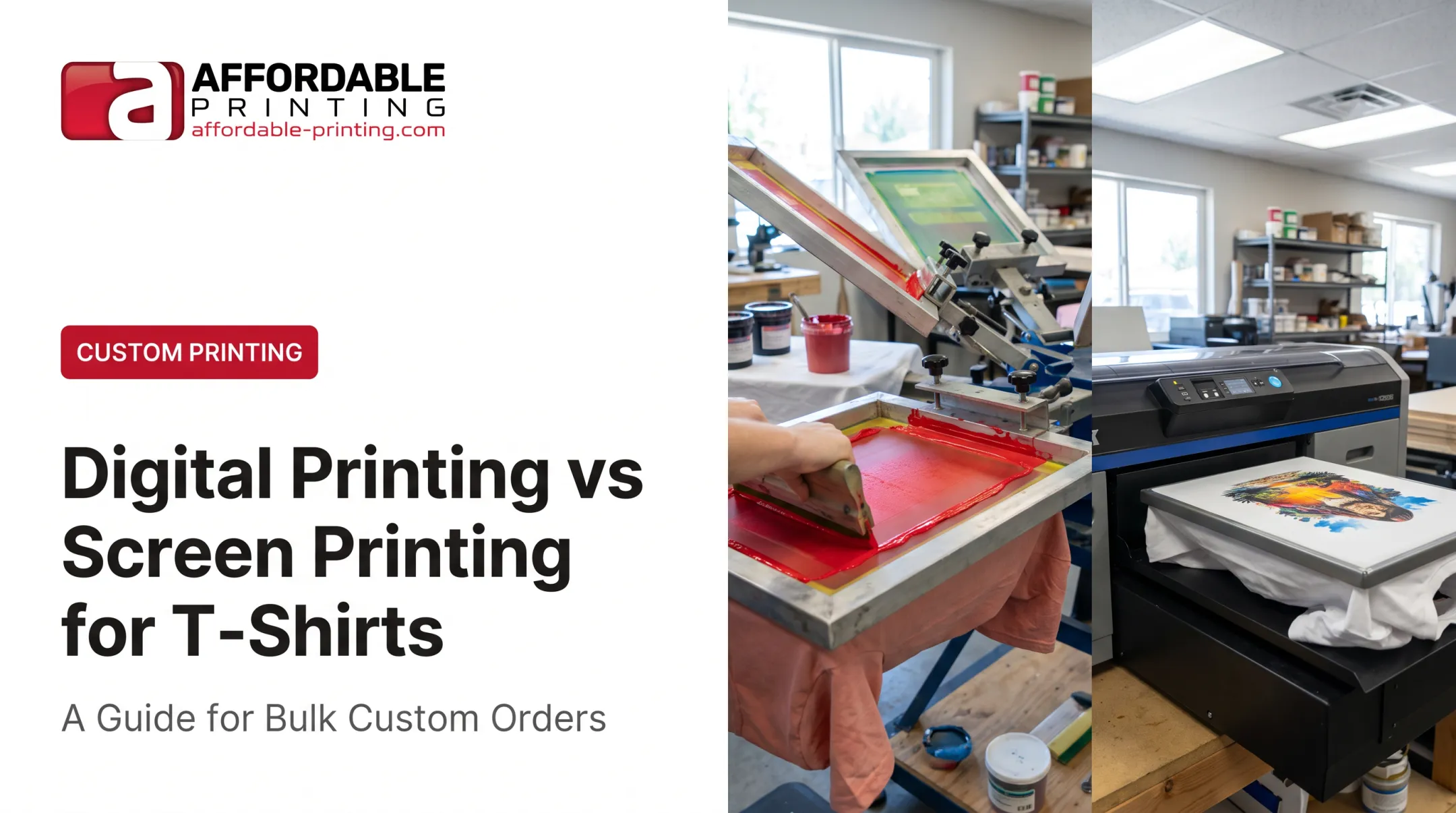
You've got a design ready and a deadline approaching, but you're stuck on one question: DTG or screen printing? Both methods produce professional custom apparel. Neither one wins every time.
The method you pick affects your setup costs, per-shirt pricing, how the print looks and feels, how long it lasts, and how fast you get your order. Choose wrong, and you might overpay for a small run or end up with a print that doesn't hold up to your artwork's detail.
According to Impressions Magazine, 10 DTG shirts can be printed in under 30 minutes, while a five-color screen print job of the same quantity took up to four hours. That's one illustration, not a universal rule, but it shows why the decision matters.
This guide breaks down the real differences so you can match the method to your project, not the other way around.
Key Takeaways
- DTG fits small orders, one-offs, and detailed artwork like photographs and gradients
- Choose screen printing for larger runs, bold graphics, and exact spot-color matching
- Compare quantity, artwork, fabric, deadline, and cost together; neither method wins by default
- Print durability depends on ink, pretreatment, curing, and washing, not just the method name
DTG vs. Screen Printing: Quick Comparison
| Factor | DTG | Screen Printing |
|---|---|---|
| Best for | Small runs, photo detail | Large runs, bold colors |
| Setup | Minimal | Screens per color |
| Feel | Soft, fabric-integrated | Slightly thicker |
| Fabric range | Cotton, cotton-rich blends | Cotton, blends, polyester |
Cost
DTG requires little setup, which makes it practical for one-off shirts or short runs. That said, DTG isn't automatically cheaper. Print size, garment type, and quantity all factor into your final price.
Screen printing works differently. Preparing screens and separating colors adds upfront labor and cost. Once that setup is done, though, production moves quickly. The more shirts you print with the same design, the lower your per-item cost drops.
Design and Color Capability
DTG blends colors digitally, which makes it a strong fit for:
- Photographic artwork
- Smooth gradients and shading
- Designs with many colors
- Fine detail work
Screen printing uses spot inks mixed to match specific colors, including shades outside a standard CMYK range. That's why it remains the go-to choice for precise Pantone matching and bold, opaque graphics like logos and text.
Fabric Compatibility
DTG generally works best on cotton and cotton-rich garments. Fabric color and blend composition can affect results, and pretreatment is often needed, especially for white ink on cotton or for printing on polyester. Epson's own equipment documentation confirms these are model-specific requirements, not guarantees across every DTG printer.
Screen printing covers more ground. With the right ink and curing process, it handles cotton, blends, polyester, and performance fabrics.
Feel and Durability
DTG ink soaks into the fabric, so prints often feel soft and barely noticeable to the touch. Screen printing sits slightly on top of the fabric, giving it a more substantial feel, though ink formulation can soften this too.
Durability isn't determined by method alone. It comes down to:
- Ink type and quality
- Pretreatment consistency
- Curing temperature and time
- Garment fabric
- Washing habits
Turnaround and Order Flexibility
DTG's digital setup means fewer preparation steps. That translates to faster turnaround for samples, personalized pieces, and short runs, with easy design changes between orders.
Screen printing needs more lead time upfront for screen prep and registration. But once you're set up, repeat runs of the same design become efficient at volume.

What Is DTG Printing?
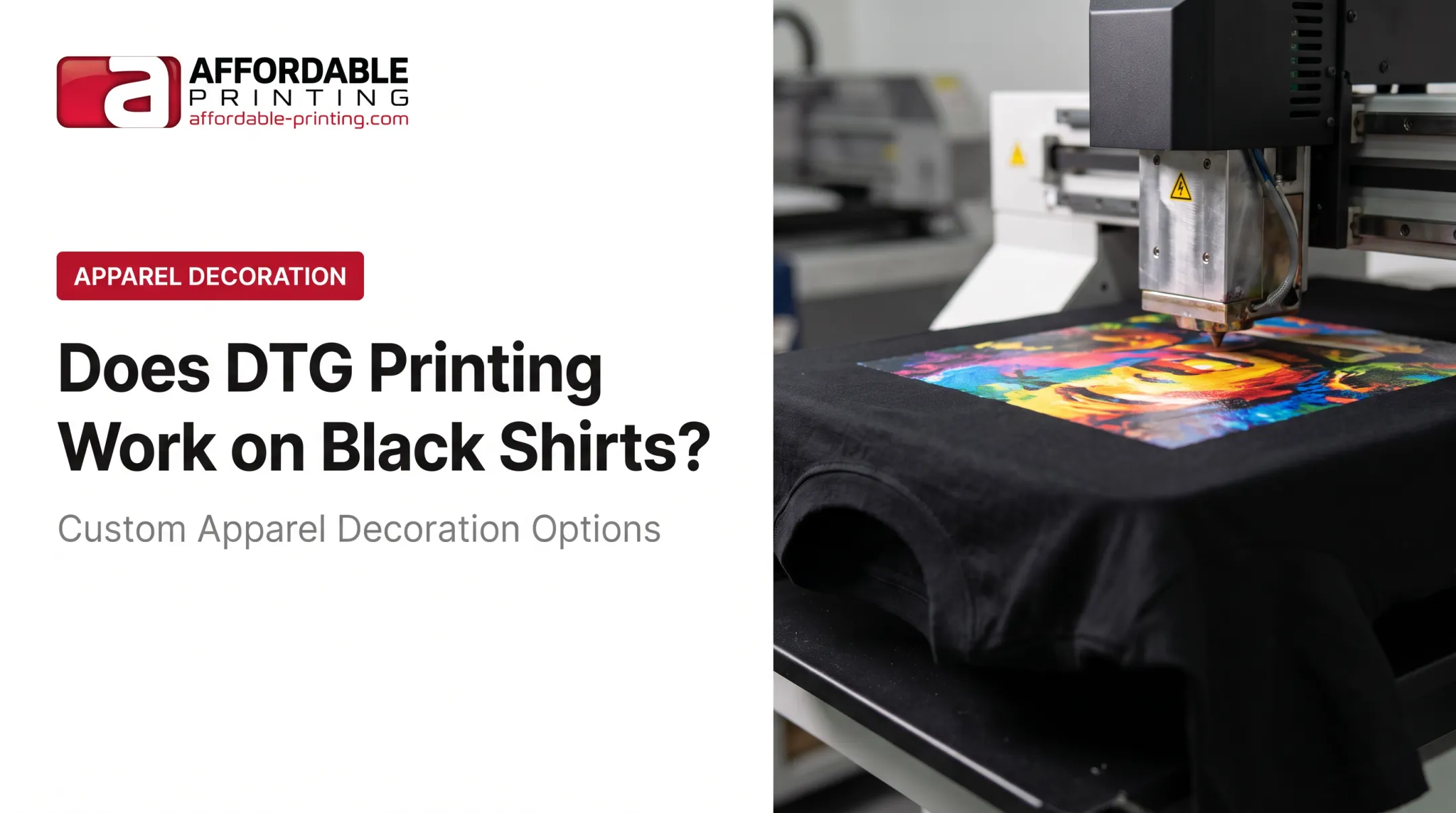
Direct-to-garment (DTG) printing applies ink straight onto fabric using specialized inkjet equipment, with no screens and no film. That's different from DTF (direct-to-film), which prints the design onto film first, then transfers it to the garment with heat.
How DTG Works
At Affordable Printing, our DTG process follows five steps:
- Artwork review and color optimization — checking files for accuracy before printing
- Garment pretreatment — preparing fabric so ink bonds properly
- High-precision printing — applying ink directly to the garment
- Heat curing — locking ink into the fibers
- Quality inspection — confirming the finished print meets standards
This workflow supports unlimited colors with no added setup cost for complex designs. That is a real advantage over screen printing's per-color screen requirement.
Benefits and Limitations
DTG's strengths include:
- Easy design changes between orders
- Photo-quality detail and smooth color transitions
- No need to prepare separate screens per color
- A soft hand feel since ink integrates into the fabric
Limitations to weigh:
- Garment fabric and color affect print results
- Print area is limited by the equipment's platen size
- Pretreatment consistency matters more than most buyers expect
"Full color" still does not mean identical results on every garment. Always review a proof and confirm brand-color expectations before your run goes to print.
When DTG Makes Sense
DTG fits projects like:
- Sample runs and prototypes
- Limited-edition merchandise
- Family reunion shirts
- Small-business branded apparel with detailed logos
- Charity or event artwork with photographic elements
- Personalized gifts
Affordable Printing's DTG service carries a 12-garment minimum, covering t-shirts, hoodies, sweatshirts, and long-sleeve items. It is a practical option for startups, creators, and smaller organizations that need detailed artwork without a bulk order.
What Is Screen Printing?
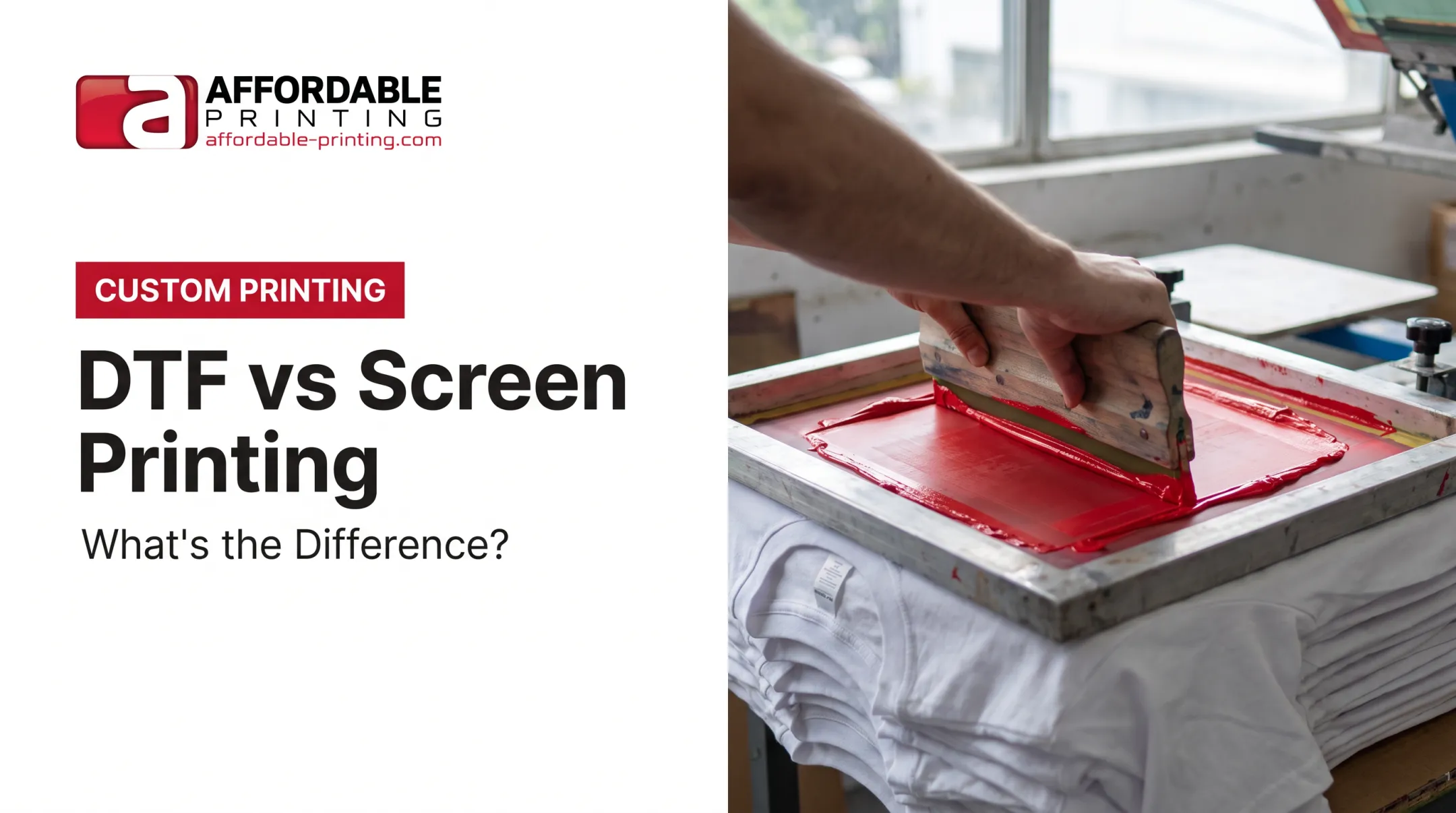
Screen printing is a stencil-based process. A squeegee forces ink through a prepared mesh screen onto the garment, with a separate screen typically used for each color in the design.
How Screen Printing Works
The typical workflow includes:
- Separate artwork by color
- Prepare screens and create stencils
- Register each color screen for precise alignment
- Apply ink one color at a time
- Flash dry between colors
- Heat cure to set the ink permanently
- Inspect the finished print
At Affordable Printing, this process produces bold, consistent prints using premium inks applied layer by layer.
Benefits and Trade-Offs
Screen printing's core strengths:
- Bold, opaque color that pops on dark garments
- Repeatable results across large quantities
- Broad garment compatibility, including polyester and performance fabrics
- Specialty ink options for unique finishes
- Lower per-item cost at higher volumes
Trade-offs to plan for:
- Setup time and screen costs raise the price of small orders
- Gradients and photo artwork need more color-separation work
- Quality and durability depend on consistent registration and curing
When Screen Printing Makes Sense
Screen printing works well for:
- Youth sports leagues and school spirit wear
- Uniforms for trade and field-service crews
- Restaurant and retail staff apparel
- Event shirts and nonprofit campaigns
- Promotional merchandise ordered in quantity
It's often the better fit for bold logos, limited-color artwork, large print areas, dark garments, or synthetic fabrics where exact spot-color matching matters. Affordable Printing handles screen printing from small team runs to large bulk orders, with volume discounts as quantities grow.
DTG vs. Screen Printing: What's Better for Your Project?
There's no universal winner here. The right call depends on how your project stacks up against a handful of practical factors, in roughly this order of importance:
- Quantity — how many pieces you need
- Artwork complexity — detailed and photographic, or bold and simple?
- Number of colors — a handful, or a full spectrum?
- Garment material and color — cotton, blend, or performance fabric?
- Print size and location — small chest logo, or full-back graphic?
- Desired feel — soft and integrated, or more substantial on the surface?
- Deadline — how much lead time do you have?
- Color-matching needs — does your brand require exact Pantone matches?
- Total budget — what's your per-item and overall spend target?
Choose DTG when you need a small quantity, personalized pieces, photographic or highly detailed artwork, frequent design changes, or a softer print feel—assuming your garment is DTG-compatible.
Choose screen printing when you need a larger quantity of identical designs, bold limited-color artwork, performance or synthetic garments, specialty inks, or strict spot-color matching.

Sometimes neither method fits perfectly. For heavily mixed fabric orders or oversized full-color graphics, DTF transfers might work better, and for a durable, stitched logo on a polo or cap, embroidery often outlasts either printed option.
Affordable Printing offers screen printing, DTG, embroidery, and DTF under one roof, so you can get a project-specific recommendation instead of forcing your order into a generic rule.
Quick Checklist Before You Request Pricing
Before reaching out for a quote, gather:
- Garment type and color
- Quantity needed
- Artwork file (and file format)
- Print dimensions and placement locations
- Deadline
- Color-matching requirements
- Whether this order will repeat in the future
Real-World Examples
Affordable Printing projects show how artwork and volume drive the method—not a blanket preference for one process. These jobs were clear screen-printing fits:
- Castle of Chaos needed event shirts for a fixed date with bold branding. Once screens were set, screen printing’s speed at volume made the difference.
- Disaster Response & Construction ordered T-shirts built for durability across repeat wear, prioritizing broad fabric compatibility over fine detail.
- Cottonwood Distribution and J&M Steel chose screen-printed workwear, where consistent crew branding mattered more than intricate artwork.
Small runs with full-color or photorealistic art usually point the other way: DTG avoids screen setup and handles complex color without a high piece count.
Customer Amanda Dunn reported every shirt printed correctly, on a fast turnaround, and priced competitively against other shops she’d contacted—proof that once the method fits the job, execution still has to hold up.
Artwork and production volume should drive your choice. If you have a fixed deadline, a repeat order, or crew-wide branding, walk the details with a printer before locking in either method.
Conclusion
DTG typically fits detailed, flexible, smaller-scale work. Screen printing typically fits bold, repeatable designs ordered in larger quantities. Neither rule is absolute, so match the method to your actual project before you commit.
Weigh these factors together:
- Garment type and fabric
- Artwork complexity and color count
- Order quantity and deadline
- Color expectations
- Print feel and total cost
When the choice still isn't obvious, request a proof or a professional recommendation rather than guessing.
Affordable Printing has offered both screen printing and DTG for custom apparel across Utah since 2003. Reach out for a free quote and a recommendation built around your specific project.
Frequently Asked Questions
What is cheaper, direct-to-garment printing or screen printing?
DTG tends to be more economical for one-offs and short runs since setup is minimal. Screen printing typically reduces per-item cost at larger quantities of the same design. Artwork, garment, print size, and color count all affect the final quote.
How is direct-to-garment printing different from screen printing?
DTG uses digital inkjet technology to apply ink directly to fabric, while screen printing forces ink through a stenciled mesh screen. DTG suits small runs and detailed art; screen printing suits bulk orders and bold graphics.
Is direct-to-garment printing better than screen printing?
Neither is always better. DTG fits detailed, full-color, or short-run work best. Screen printing fits larger runs, bold artwork, specialty inks, or broader fabric needs best.
Is direct-to-garment printing as high-quality as screen printing?
Both can produce high-quality apparel. Their strengths just differ. DTG typically excels at fine detail and gradients, while screen printing typically excels at opaque, vibrant spot colors and specialty finishes.
What lasts longer, screen printing or direct-to-garment printing?
Longevity depends on ink, garment, pretreatment, curing, and washing, not the method alone. A correctly produced DTG print can last just as long as a well-cured screen print.
How can I tell if a shirt was printed with DTG or screen printing?
Surface feel, ink thickness, and color transitions offer clues. DTG often feels softer with smoother gradients. Visual inspection isn't definitive, though; a printer's production record is the more reliable answer.