Introduction
You've settled on a logo. Now you need it on shirts, hats, or jackets — and the next decision is which decoration method will actually look right on the garment.
DTG printing sprays ink directly into fabric fibers, producing a soft, photo-quality image. Embroidery stitches thread through the material, building a raised, textured design that can hold up for years of hard wear. Neither method wins across the board. The right pick depends on your artwork, your garment, how often it gets washed, your order size, and your budget.
This guide breaks down the real differences: cost factors, design complexity, durability, feel, and where each method makes sense, so you can order apparel that looks right and holds up.
Key Takeaways
- DTG printing handles detailed, full-color artwork, photos, and gradients with a soft, breathable finish.
- Embroidery stitches thread into fabric for a raised, durable finish ideal for logos, uniforms, and headwear.
- Choose DTG for design flexibility; choose embroidery for texture and long-term fade resistance.
- Base your pick on artwork complexity, garment type, expected wear, and total project cost.
DTG Printing vs Embroidery: Quick Comparison
Here's how the two methods stack up across the factors that matter most for ordering decisions.
| Factor | DTG Printing | Embroidery |
|---|---|---|
| Cost | Often more economical for detailed, multicolor art and smaller runs | Depends on digitization, stitch count, garment type, and design size |
| Design complexity | Handles gradients, photos, full-color art | Best for simplified logos, bold text, limited detail |
| Durability | Depends on curing, garment quality, and wash care | Sewn thread resists fading; dense stitching or poor backing can still cause issues |
| Feel | Flat, soft, breathable | Raised, tactile, premium |
| Best garments | Stable, flat cotton or blend fabrics | Hats, polos, jackets, bags, heavier fabrics |
Cost: What Drives the Price
DTG skips physical screens and, in most cases, skips embroidery digitization too. That makes it practical for detailed designs in smaller quantities, since you're not paying setup fees per color. Printful's 2026 comparison guide notes DTG is usually the more economical choice for intricate, multicolor art, though that's a general trend rather than a fixed rule.
Embroidery pricing works differently. Your quote depends on:
- Digitization — converting artwork into a stitch file
- Stitch count — denser designs take longer to sew
- Garment type — caps, jackets, and knits need different backing
- Thread requirements — specialty threads add cost
Because these variables shift project to project, always get a current quote rather than assuming one method is cheaper. Affordable Printing's DTG orders start at a 12-piece minimum, while embroidery covers everything from a single custom jacket to hundreds of caps, with no minimums on select items.
Design Complexity and Color
DTG's inkjet process reproduces smooth gradients, shading, and photographic detail without the color limits screen printing or embroidery run into. Fine text, blended colors, or a photo-realistic element usually translate more faithfully through DTG.
Embroidery takes a different path. Each thread carries one fixed color, so blending requires interspersing stitches, and a digitizer often simplifies busy artwork so it stitches out cleanly. Bold lettering and simple, high-contrast logos generally convert best.
Durability and Care
Properly cured DTG prints hold up through repeated washing. Brother's curing guidance for its GTX printers points out that both under-curing and over-curing the ink and pretreatment can shorten print life. Production quality matters as much as the garment itself. Washing inside out and air-drying helps too.
Embroidery thread is built to resist fading. As one benchmark, Madeira's Polyneon No. 40 embroidery thread scored 4-5 for wash fastness under industry testing at 95°C (203°F). That is a strong result for that specific thread, not a universal wash-count guarantee for every embroidered garment. Dense stitching, poor backing, or snagging can still affect longevity over time.
Feel and Appearance
DTG lays flat against the skin. Ink soaks into the fibers rather than sitting on top, so the garment stays soft and breathable — ideal for large graphic designs across a T-shirt's chest or back.
Embroidery sits above the fabric. That raised texture reads as more premium and durable, which is exactly why it shows up on polos, jackets, and caps where a professional look matters. The tradeoff: heavily stitched designs can feel stiffer, especially on lightweight fabric.
Garment and Placement Compatibility
DTG needs a stable, relatively flat printing surface — T-shirts, hoodies, sweatshirts, and long-sleeve shirts. Fabric composition affects both ink adhesion and how colors appear once printed, which is why cotton and cotton blends remain the go-to choice.
Embroidery thrives on structured garments: hats, polos, jackets, bags, and heavier fabrics that support stitching without puckering. Dense, detailed designs on thin or stretchy fabric can distort the material, so garment choice matters as much as artwork.
What Are DTG Printing and Embroidery?
What Is DTG Printing?
Direct-to-garment printing is a digital process. An inkjet-style printer applies water-based ink straight onto fabric. Most garments get pretreated first so the ink bonds properly, then the print is heat-cured to lock everything in.
The result is a flat image built into the fabric itself, not sitting on top of it. Affordable Printing's DTG process follows this sequence: artwork review, color optimization, pretreatment, printing, and quality inspection. That prep helps the ink bond cleanly so the print holds up through washing.

Advantages:
- Broad color reproduction, gradients, fine detail, and unlimited colors with no per-color setup fees
- No physical screens, so switching designs between orders is simple
- Practical for small-batch orders and one-off pieces
Limitations:
- Works best on stable, relatively flat fabric like cotton or cotton blends
- Color can shift slightly between digital artwork and the finished print
- Placement is somewhat limited by the printer's flatbed size
- Requires proper file prep and garment care to maximize print life
DTG fits event shirts, artist merchandise, family reunion apparel, school spirit wear, charity campaigns, and full-color promotional garments. It works anywhere detailed, colorful artwork matters more than texture.
What Is Embroidery?
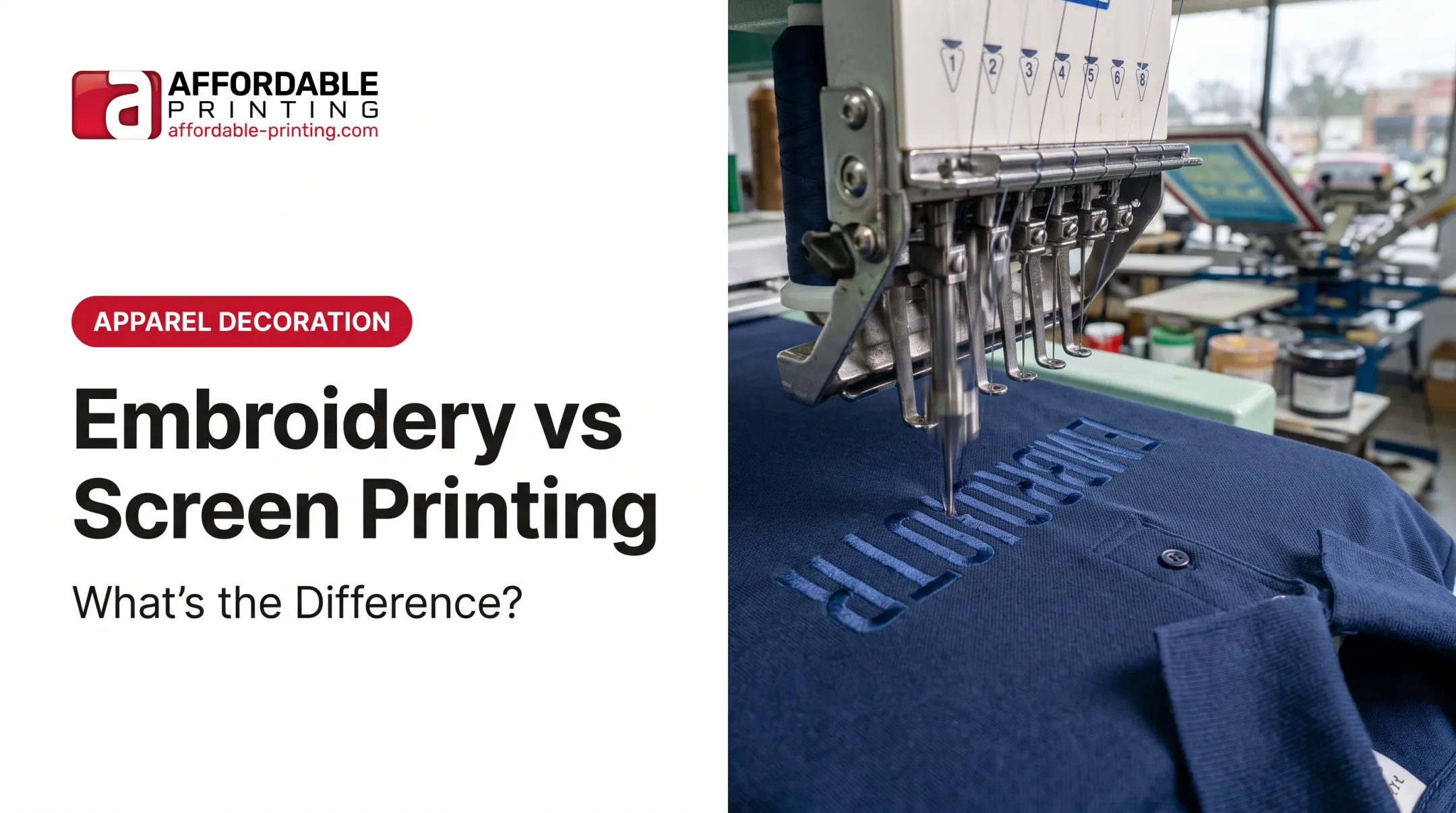
Embroidery converts artwork into a stitch file through digitization, then a multi-needle machine sews thread directly into the garment. The process typically involves hooping the fabric with a stabilizer backing, then stitching using a mix of straight, satin, and fill stitches depending on the design.
Backing choice matters: stretchy knits generally need cut-away support to stay stable through repeated wear, while stable, heavyweight wovens can use tear-away backing. The exact process varies by provider and garment.
The finished design sits raised above the fabric. It feels textured and tactile, and it often reads as more premium than a flat print.
Advantages:
- Strong durability and fade resistance from sewn thread
- Tactile, professional appearance that reads well from a distance
- Works well on structured and heavier garments
Limitations:
- Not suited to photographs or tiny, intricate detail
- Cost scales with stitch count, so dense designs cost more
- Can add stiffness, and unsuitable fabric may pucker or distort
Affordable Printing's embroidery uses precision digitizing and fade-resistant polyester and rayon threads built for industrial washing and daily wear. Common applications include work uniforms, polos, hats, jackets, medical and care-staff apparel, restaurant garments, and corporate gifts.
DTG Printing vs Embroidery: What Is Better?
Neither method wins across the board. DTG is the stronger fit for complex, colorful artwork on soft-feel apparel. Embroidery wins for durable logos and professional workwear.
Choose DTG when your project needs:
- Full-color graphics, photos, gradients, or fine details that would be hard to simplify into stitches
- A soft, lightweight finish on cotton or manufacturer-approved fabric: T-shirts, sweatshirts, event apparel, merchandise
- Short runs, samples, or designs that change frequently, where setup costs matter
Choose embroidery when your project needs:
- A simple logo, monogram, bold text, or compact chest design with a raised, premium look
- Durable branding on hats, polos, jackets, bags, or uniforms exposed to frequent wear
- A polished, professional appearance for crews, corporate teams, restaurants, schools, and healthcare organizations
Five Questions to Guide Your Decision
- What does the artwork look like? Photo-realistic or gradient-heavy art leans DTG; simple, bold logos lean embroidery.
- What garment will carry it? Flat cotton apparel suits DTG; structured items like caps and jackets suit embroidery.
- How often will it be washed or worn? Frequent, heavy wear often favors embroidery's texture and thread durability.
- What quantity is needed? Smaller, varied runs often favor DTG's lower setup burden.
- What finish do you want people to see and feel? Flat and graphic, or raised and tactile?
Some projects don't have to choose. A hybrid approach (DTG for a detailed front graphic, embroidery for a small chest logo) works when the garment and placement support both methods on one piece.
Real-World Examples and Decision Scenarios
Field-Service and Workwear Orders
Plumbing, HVAC, electrical, landscaping, and construction crews need branding that survives grease, sun, and repeated washing. Embroidered logos on polos, jackets, and caps hold up to that wear and keep crews consistent across job sites.
Best fit for workwear:
- Embroidery on polos, jackets, and caps for daily uniform use
- Durable thread that resists fading, peeling, and heavy wash cycles
- Reorders as you hire, without redesigning a full-color print each time
Affordable Printing's portfolio follows the same pattern, including embroidered workwear for Utah Fence Warehouse and an embroidered patch for Carver Construction.
Event, Charity, School, and Sports Orders
A 5K, festival, school program, or family reunion often needs shirts fast, in mixed sizes, sometimes with sponsor logos or photos. DTG fits that brief: no screens to set up, and full color is included by default.
Staff polos or volunteer caps for the same event are different. A simple embroidered logo usually beats a full-color print on structured headwear.
Best fit for events and teams:
- DTG for short-run participant tees with complex or multicolor art
- Embroidery for staff polos, caps, and repeat volunteer gear
- Choose based on deadline, design detail, and garment type—not a fixed minimum
Business Merchandise and Promotional Orders
Restaurants, breweries, retailers, and orthodontic practices often need both: DTG graphic tees for customer-facing merch, and embroidered polos or jackets for staff. Affordable Printing's portfolio includes embroidered corporate polos for ThermoWorks and embroidered caps for Terracon—clear cases of one business standardizing embroidery on team apparel.
Best fit for business merch:
- DTG tees when the shirt is a colorful giveaway or keepsake
- Embroidery when staff will wear the piece daily as a uniform
- A split order when you want retail merch and polished staff gear from one plan
If you're weighing DTG against embroidery for an upcoming order, Affordable Printing can review your artwork, garment, and budget and recommend DTG, embroidery, or a coordinated mix.
Before you order, gather:
- Artwork file (vector works best for embroidery)
- Garment style and logo placement
- Quantity and deadline
- Expected wear and wash frequency
- Proof request (digital mockup or physical sew-out)
- Notes on digitizing, art prep, or setup fees
Conclusion
Choose DTG for complex, colorful, soft-feel graphics. Choose embroidery for durable, professional, tactile branding. Some projects benefit from both methods on the same garment, like a detailed front print paired with a small embroidered logo.
Match the decoration method to your project:
- Artwork and color complexity
- Fabric type and placement
- Expected use and durability needs
- Order quantity and total cost
Before placing a larger order, request a sample, a proof, or a professional recommendation. Affordable Printing offers both DTG and embroidery, so you can compare options against your garment and goals in one place.
Frequently Asked Questions
What is better, DTG printing or embroidery?
DTG fits detailed, full-color graphics. Embroidery fits durable logos, uniforms, hats, and premium textured branding. Choose based on design complexity, garment type, and how the piece will be worn.
Is DTG cheaper than embroidery?
DTG can cost less for detailed designs or smaller quantities because it skips digitization. Embroidery pricing depends on stitch count, garment type, and design size—compare both with a project-specific quote.
Which lasts longer, DTG printing or embroidery?
Embroidery's sewn thread usually resists heavy wear and fading. DTG can also hold up well when properly cured and cared for, so garment quality and care matter as much as the method.
Is DTG or embroidery better for business logos?
Embroidered logos suit uniforms, polos, hats, and jackets where a raised, professional finish matters. DTG works better for logos with complex color, gradients, or larger graphic elements that need more detail than stitching allows.
Can DTG printing and embroidery be used on the same garment?
Yes, the two methods can sometimes be combined on one piece. Production order, garment stability, placement, and design density all need review before approval to make sure both methods hold up.