_1782777776334-CjnZ693B.png)
June 30, 2026
Screen Printing Minimum Order FAQ
A marketing coordinator in Salt Lake City usually asks the same question first: what is the minimum? That is exactly why this screen printing minimum order FAQ matters. If your company is ordering branded shirts for a team, event, or staff rollout, the minimum affects price, method, timeline, and whether screen printing is even the best fit.
At our shop, the standard minimum for custom apparel is 12 pieces. That is true for many business orders across the Wasatch Front because most company apparel projects start with a team size, department launch, training event, or staff uniform count that easily gets there. The bigger point is not just the number. It is why the number exists and how it helps you choose the right decoration method for your order.
Screen printing minimum order FAQ: why shops have minimums
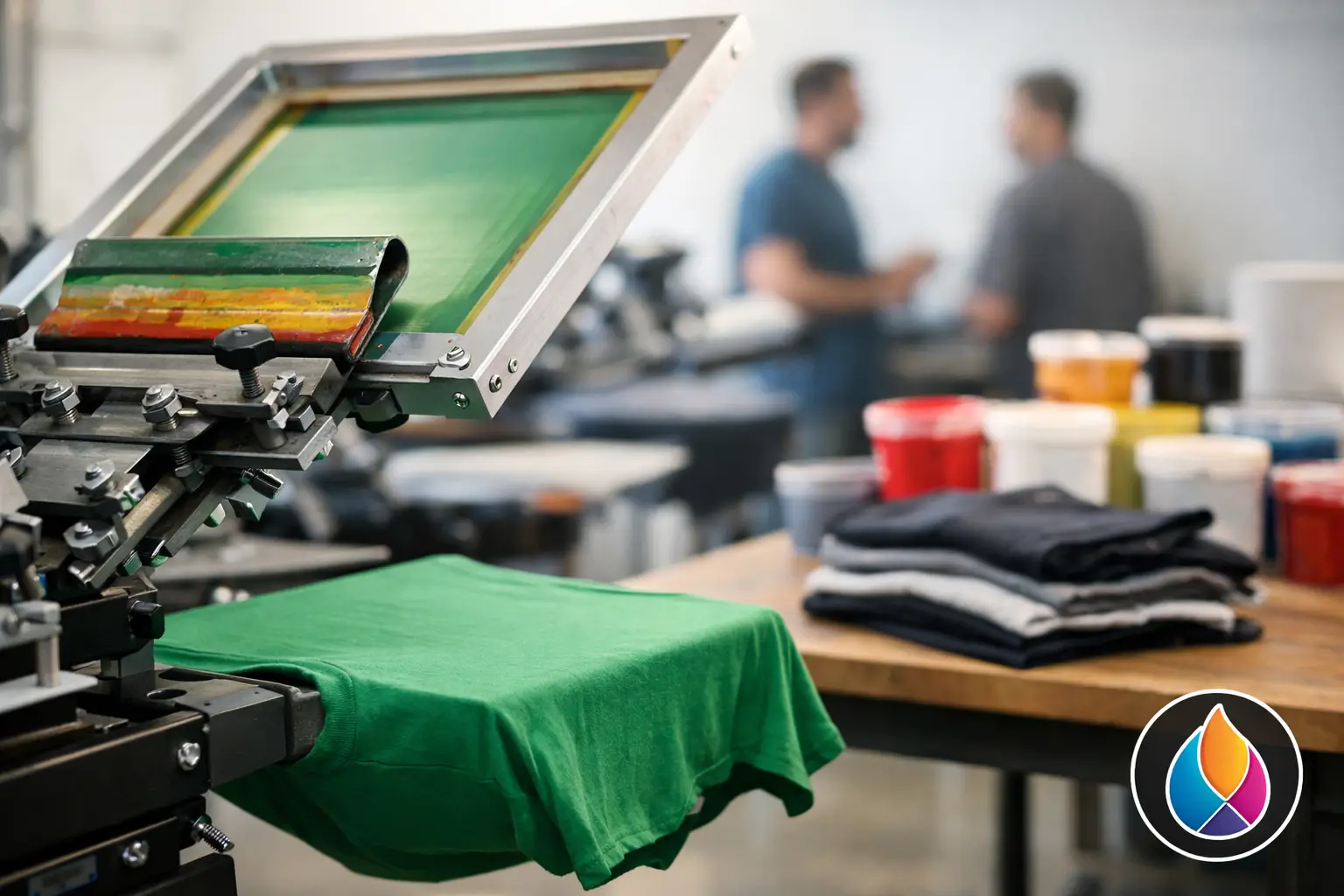
Screen printing has setup work built into every job. Before a single shirt is printed, artwork has to be prepared, screens have to be created, inks have to be mixed, and the press has to be set for the exact print locations and colors. That front-end labor is the same whether your company needs 12 shirts or 120.
That is why minimums are common. They help spread setup cost across enough pieces to keep the per-shirt price reasonable. For a business buyer, that usually works in your favor. Once you reach the minimum, screen printing often becomes one of the most cost-effective ways to outfit your employees or produce event apparel at scale.
If you are ordering for a trade show, warehouse crew, school staff, or nonprofit volunteers, minimums are less about making things difficult and more about matching the right process to the job. Screen printing shines when you need consistency, strong color, and a better unit price on a group order.
What the minimum means for your company order
A minimum does not always mean every item has to be identical in every way. In many cases, a business order can include a size run across the same garment style and artwork. Small through 3XL can still count toward one production run if the print stays the same. That is how most uniform and event orders are built.
Where it gets more complicated is when your team wants multiple garment styles, different print locations, or several artwork versions. For example, if your sales team wants polos with embroidery, your warehouse team wants tees with a front print, and your managers want zip hoodies, those may be separate production setups. The total quantity may be high, but each decoration method and design version can have its own practical minimum.
This is where good planning saves money. If your company can standardize the artwork and garment selection, screen printing usually gets more efficient fast.
Does 12 pieces mean 12 per design?
Often, yes. The cleanest way to think about it is 12 pieces per decoration setup. If all 12 shirts use the same design, same ink colors, and same print placement, that is a straightforward screen printing order.
If you split the job into six shirts with one logo and six with another, that may function like two smaller jobs instead of one. The total count is still 12, but the production setup is no longer the same. For business buyers, this matters most when departments want their own version of a shirt or event sponsors need different back prints.
Can you mix sizes within the minimum?
Yes, and that is normal. Most team and company orders include a size breakdown. A 12-piece order might include a mix of small, medium, large, XL, and extended sizes. That does not usually create a problem as long as the garment style and print stay consistent.
Can you mix garment colors?
Sometimes, but it depends on the artwork and ink choice. If your company logo is printed in white, it may work across several dark shirt colors. If the print needs different ink formulas to maintain contrast, the job can become more complex. This is one of those areas where there is no universal yes or no. It depends on how consistent the final branded look needs to be.
When screen printing makes the most sense
Screen printing is usually the best fit when your business wants 12 or more pieces with the same artwork and you care about clean, durable branding. It is especially strong for staff shirts, event tees, construction crews, school spirit wear, and promotional apparel where you need repeatable quality across a larger group.
It also makes sense when color accuracy matters. If your company brand standards matter, Pantone color matching can help keep printed apparel aligned with your logo colors. That is useful for corporate events, franchise groups, and organizations that need consistent branding across multiple runs.
For bigger quantities, screen printing usually has the best pricing curve. As your quantity increases, the setup cost is spread across more garments, and your cost per piece often drops.
When DTF or DTG may be a better option
Not every order should be screen printed. If your company needs a smaller quantity, multiple names, highly detailed artwork, or a full-color image, DTF or DTG may be the smarter route.
DTF works well for shorter runs and designs that would be expensive or inefficient to separate into screens. It is often a practical choice for employee names, complex graphics, or multi-version team apparel. DTG can also work well for detailed, full-color prints on smaller quantities, especially when the artwork has gradients or photographic elements.
For business buyers, the trade-off is simple. Screen printing usually wins on unit cost and durability for larger matching orders. DTF and DTG usually win on flexibility for smaller or more customized runs. If your order is right around the minimum, the best method depends on your artwork, garment type, and budget goals.
Common questions behind the minimum
A lot of customers ask whether they should add extras just to hit the minimum. In many cases, yes, that is smart. Ordering a few spare shirts for new hires, event backups, or size exchanges is usually cheaper than placing a second run later. If your office is rolling out uniforms in South Jordan or sending a team to a conference in Ogden, extras tend to get used.
Another common question is whether bringing your own garments changes the minimum. Not usually. The production setup still exists, regardless of where the garments came from. What can change is how much flexibility the order has, since customer-supplied apparel can introduce fabric, sizing, or consistency issues that affect print results.
Turnaround is another concern. Our standard production timeline is 12 business days from artwork approval, and we often finish sooner. Rush orders are available when timing is tight, but the best way to keep your project moving is to finalize artwork, sizes, and garment choices early. Minimums are only one part of the schedule. Approval delays are often the bigger issue.
How to plan your order so the minimum works for you
If you are buying for your company or organization, the easiest way to avoid surprises is to build the order around one clear use case. Decide who the garments are for, what the artwork needs to do, and whether everyone should be in the same item. A staff uniform program is different from an event giveaway, and both are different from executive apparel.
Next, think about quantity beyond the exact headcount. Headcount is rarely the real order count. New employees join, volunteers forget sizes, and event teams always need a few extras. Ordering only the bare minimum can look cheaper on paper, but it often creates a more expensive reorder later.
Finally, ask about decoration methods before locking in your artwork. Some logos are ideal for screen printing. Others are better suited for embroidery, DTF, or DTG. The wrong method can raise cost or reduce clarity. The right method keeps the order efficient and the finished product looking professional.
Screen printing minimum order FAQ for Utah business buyers
For most business apparel projects, the minimum is not the problem. The real issue is matching the order to the right production method. If your company needs at least 12 pieces with consistent branding, screen printing is often the strongest choice. If the job is smaller, more detailed, or more customized, another method may fit better.
That is how we approach orders for businesses, schools, nonprofits, and event organizers across Salt Lake City and the Wasatch Front. We keep it practical, explain the trade-offs clearly, and help you choose the option that makes sense for your team, your timeline, and your budget.
If you want pricing or help sorting out quantities, call (801) 260-0606 or request a free quote at affordable-printing.com/request-a-quote/.
Ready to start your order?
GET A FREE QUOTE