
October 23, 2026
Staff Uniform Sizing Guide for Better Team Orders
A staff uniform sizing guide can prevent one of the most common problems in company apparel orders: a box of branded shirts that looks great but does not fit the people expected to wear them. For a Salt Lake City business, school, or event team, getting sizes right protects your budget, keeps your employees comfortable, and helps your uniforms actually get worn.
Sizing is not just an administrative detail. It affects how professional your team feels on the job, whether employees layer their uniform during a Utah winter, and how many costly replacement pieces your company needs after delivery. The good news is that a better process does not require guessing or collecting complicated body measurements from every employee.
Start With the Actual Garment, Not a Generic Size
A medium polo is not always a medium hoodie, jacket, or performance tee. Even two garments labeled as the same size can fit differently because of the brand, fabric weight, cut, and intended use. A unisex cotton T-shirt may fit more generously through the body than a moisture-wicking quarter-zip. A fitted women’s polo may run differently than a relaxed women’s work shirt.
That is why the garment’s own size chart should guide your order. Before your company collects sizes, decide on the specific style or narrow the choices to a few approved options. Then share the measurements for those exact garments with your employees. Our team can provide garment sizing information during the quote and approval process, so your staff is not selecting sizes from memory alone.
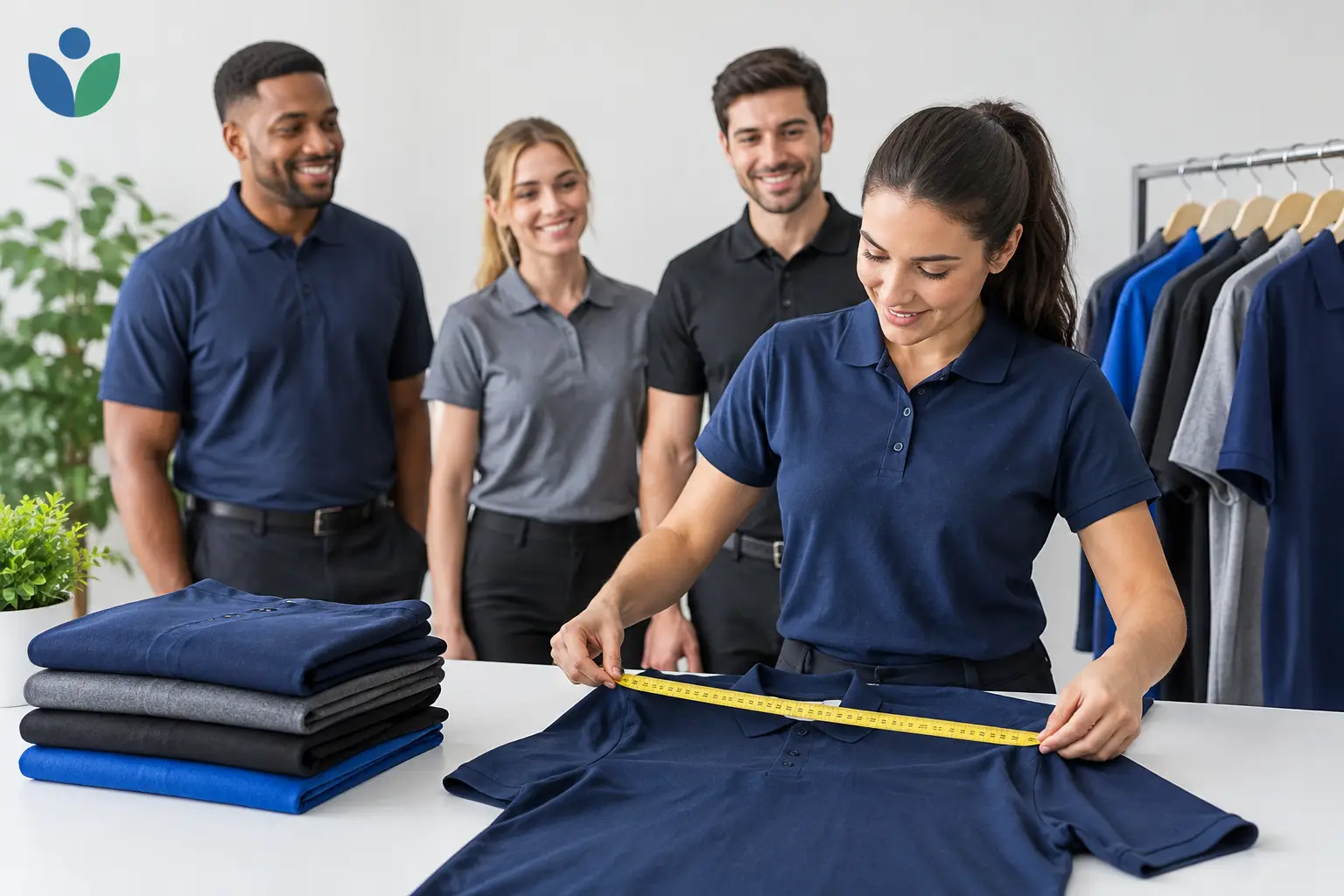
Ask employees to compare the chart with a shirt, polo, or jacket they already own and like wearing. They should lay that item flat, measure across the chest just below the armholes, and compare it with the garment chart. This is usually more reliable than asking someone to estimate their chest measurement.
Build a Staff Uniform Sizing Guide Employees Will Use
The best sizing form is short, clear, and tied to a deadline. A long form with too many choices often leads to incomplete responses and last-minute guesses. For most company uniform orders, employees need to provide their name, garment selection if applicable, size, and any special fit notes.
Include the garment name and a plain-language description. For example, write “Men’s/unisex performance polo” or “Women’s relaxed-fit full-zip jacket,” rather than using only a product number. If your company is offering both unisex and women’s cuts, make the distinction easy to see. Do not assume employees know which cut they prefer based on the word “ladies” or “unisex.”
It also helps to add one practical instruction: when between sizes, choose based on how the garment will be used. Employees who wear a polo in a heated office may prefer a closer fit. Field crews, warehouse employees, and teams that layer over a shirt may need more room. Neither choice is wrong, but the intended work environment should shape the decision.
For orders of 12 or more pieces, a shared spreadsheet or simple digital form works well. Have one person - usually an office manager, HR contact, or team lead - review the entries before submitting the order. That final review catches duplicate names, missing sizes, and a surprising number of entries such as “large-ish.”
Choose Fits That Match the Work
A uniform program works better when the garment is selected for the job, not just the logo placement. Screen printing, embroidery, DTF, and DTG can all create sharp branded apparel, but the decoration method does not change the need for a useful fit.
Office and customer-facing teams
Polos, button-downs, quarter-zips, and lightweight jackets are common choices for office staff, sales teams, and customer-facing employees. Look at shoulder width and body length as closely as chest measurements. A polo that is too short can ride up when someone reaches or sits, while a jacket that is too narrow in the shoulders can feel restrictive all day.
For embroidered polos and outerwear, remember that employees may wear these garments repeatedly in front of customers. Comfort matters as much as appearance. Offering a women’s cut and a unisex or men’s cut often gives teams better options without making the order difficult to manage.
Field, warehouse, and service teams
For crews who lift, bend, drive, or work outdoors, allow room for movement and layering. A heavyweight hoodie may be useful for a winter jobsite in Draper or Ogden, but employees may need a larger size if they wear it over a uniform shirt. A lightweight performance shirt can be more practical for summer events, delivery teams, or active staff.
Pay attention to sleeve length, shirt length, and fabric stretch. A slightly roomier fit is often the safer choice for physically active work. On the other hand, ordering everything oversized can create a sloppy appearance and make some employees less likely to wear the uniform. The right answer depends on the garment and the job.
Event staff and volunteer groups
For a one-time corporate event, nonprofit fundraiser, race, or school program, sizing can be less predictable because people may join close to the event date. In those cases, organizers often order a few extra common sizes. Medium, large, XL, and 2XL are usually the most useful extras, but the mix should follow your team’s actual past orders when possible.
Avoid ordering extras based solely on assumptions about age, job title, or gender. A prior event roster is far more useful. If there is no history to use, choose a versatile garment with a forgiving fit rather than a narrow, fashion-forward cut.
Plan for New Hires and Replacement Pieces
Uniform sizing should account for what happens after the initial order. New employees join. A shirt gets damaged. A team member discovers that the jacket they chose does not work over winter layers. Planning a small reserve can save time later, especially if your company has consistent hiring or seasonal staff.
There is a trade-off. Ordering too many extras ties up budget and can leave your company with outdated apparel if the logo or role changes. Ordering none may mean a new employee starts without a matching uniform. For most businesses, the practical middle ground is a limited stock of the most common sizes in the core garment, not every style and every size.
If you expect frequent additions, consider keeping the main uniform simple. A standard polo or tee in one color is easier to replenish than a multi-piece package with several specialized garments. You can still use embroidery for durable polos and jackets, screen printing for larger runs, or DTF and DTG for detailed full-color artwork. The key is choosing a repeatable program your company can maintain.
Avoid These Common Sizing Mistakes
The first mistake is collecting sizes before selecting the garment. Employees may tell you they wear a large, but that answer means little without a specific style and chart. The second is treating unisex sizing as the same thing as a men’s fit. Unisex garments can work well for many teams, but they are not automatically the best choice for every employee.
Another common issue is waiting until artwork is approved to begin collecting sizes. Artwork approval and sizing can move forward at the same time once the garment choices are clear. Starting early gives the coordinator time to follow up with employees and reduces pressure on the production schedule.
Finally, do not rely on a manager to guess for employees who have not responded. It may feel efficient, but incorrect assumptions create more work later. A clear deadline and a reminder usually produce a better result.
Give Your Team Enough Time to Decide
For most company apparel projects, give employees several business days to review the size chart and respond. This matters even more for jackets, outerwear, or garments with several fit options. Once final artwork and order details are approved, Affordable-Printing’s standard turnaround is 12 business days, and we often finish sooner. Rush orders may be available when your timeline is tight.
A well-organized size collection makes every other part of the project easier, from selecting the right blanks to applying your logo with screen printing, embroidery, DTF, or DTG. It also means your employees receive apparel they can wear comfortably and represent your company with confidence.
For help selecting garments and organizing sizes for your team, call Affordable-Printing at (801) 260-0606 for a free quote.
Ready to start your order?
GET A FREE QUOTE