
August 20, 2026
A Guide to Branded Event Merchandise That Works
A crowded registration table in Salt Lake City tells the story quickly. If attendees grab an item, carry it through the event, and take it home, your branding keeps working. If it stays in a box after the event, it was only an expense. This guide to branded event merchandise helps your company or organization choose items people will actually use, order the right quantities, and keep production on track.
For corporate events, school fundraisers, tournaments, nonprofit walks, and conferences, the best merchandise is not always the cheapest item or the flashiest one. It is the item that fits the audience, the setting, and the purpose of the event.
Start With What the Merchandise Needs to Do
Before choosing shirts, drinkware, bags, or pens, decide what result matters most. A staff shirt has a different job than a sponsor gift. A giveaway at a trade show needs to be easy to carry, while merchandise for a company retreat may need to feel more personal and durable.
For your corporate event, branded merchandise usually falls into one of four roles: identifying staff and volunteers, thanking attendees or employees, supporting a sponsor package, or creating a useful takeaway that extends brand visibility after the event. One order can cover more than one role, but trying to make every item do everything often leads to a weak choice.
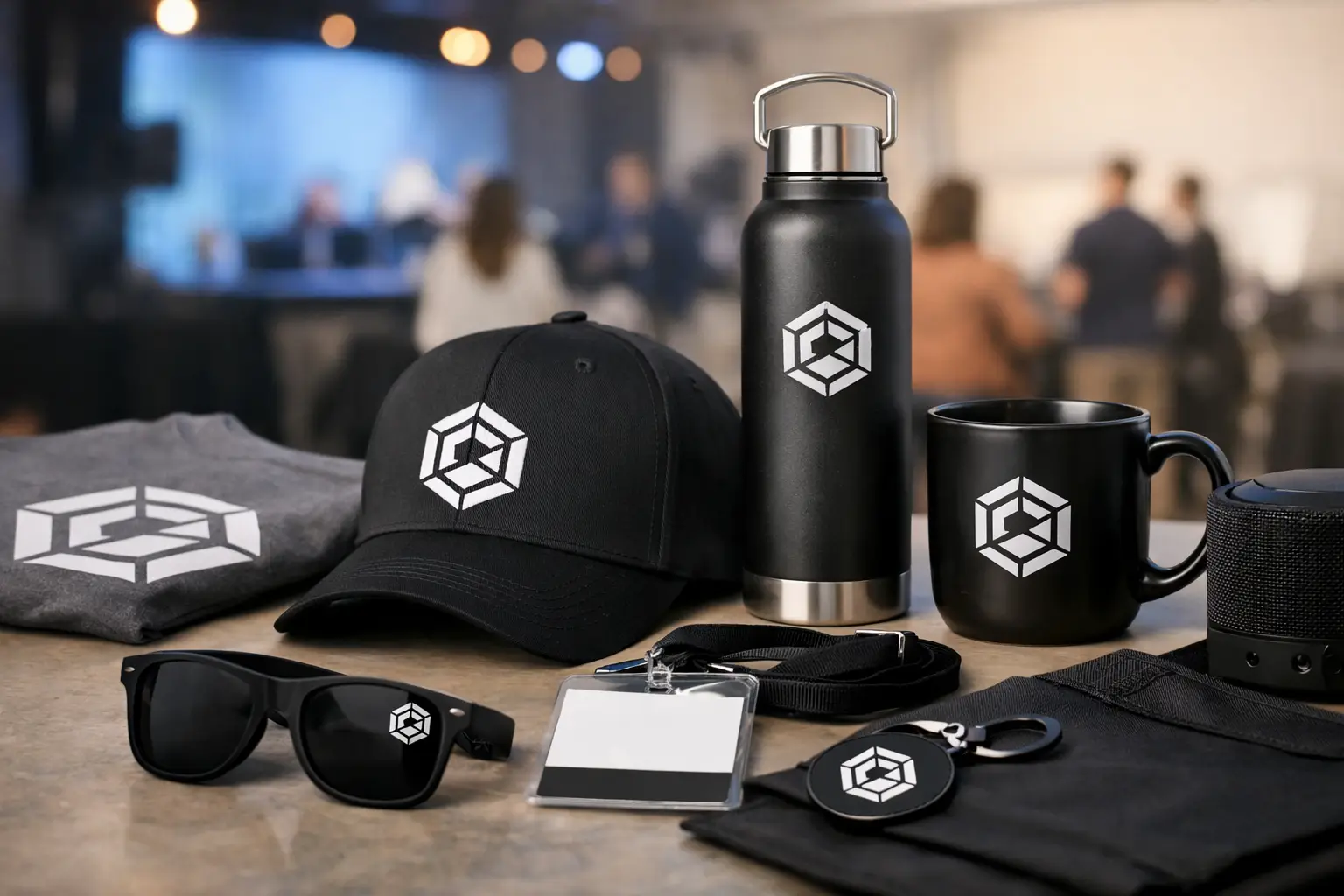
For example, embroidered polos make sense for event staff, board members, and executive guests because they look professional and hold up over time. A printed tote bag may be a better attendee item at a conference where people need somewhere to carry programs and handouts. For a 5K or community event, a soft T-shirt and a practical water bottle are often more useful than a collection of small novelty items.
Choose Products People Will Keep
Useful merchandise earns more impressions because it stays in circulation. That does not mean every event needs expensive gifts. It means the product should have a clear place in the attendee's routine.
Drinkware, tote bags, backpacks, lanyards, notebooks, pens, caps, and apparel remain popular because they solve ordinary problems. A quality insulated tumbler can work well for employee recognition or a sponsor level with a smaller guest list. A reusable tote can make sense for a larger Salt Lake City convention. Lanyards are practical when badges are required, and they can also support a clean, organized check-in process.
Apparel deserves extra attention because sizing adds complexity, but it can create the strongest connection to an event. Choose a garment based on how it will be worn. Lightweight performance shirts suit outdoor races, volunteer crews, and summer events. Cotton or blended tees work well for reunions, school groups, and community gatherings. Polos, quarter-zips, and jackets are better for staff uniforms, company golf events, or leadership groups.
Avoid choosing an item only because it has a large printable area. A giant logo on an item nobody wants is still not a good investment. It is usually better to choose a useful product with a clean, readable imprint.
Match the Decoration Method to the Item
The product is only half the decision. The decoration method affects appearance, durability, lead time, and cost. Our team regularly helps event organizers choose between screen printing, embroidery, DTF, and DTG based on the artwork and the garment.
Screen printing for larger apparel runs
Screen printing is a strong choice for T-shirts, hoodies, sweatshirts, and many event uniforms, especially when your design uses solid colors and you need a consistent look across a larger order. It produces durable, bold artwork and gives us the ability to Pantone match ink colors when brand accuracy matters.
The trade-off is setup. Designs with more ink colors generally require more production work, so a simple one- or two-color event logo is often more cost-effective than a complicated full-color graphic. For races, volunteer shirts, school events, and company gatherings, that simplicity can also make the design easier to read from a distance.
Embroidery for a polished, long-term look
Embroidery works particularly well on polos, hats, jackets, bags, and professional apparel. It gives a logo dimension and a finished appearance that fits employee uniforms, sponsor gifts, and staff clothing your team will use well beyond the event date. We can match thread colors closely to your brand colors.
Small details matter with embroidery. Fine text, tiny gradients, and highly detailed artwork may need to be simplified so the logo stitches cleanly. A good embroidered design is usually compact, clear, and sized appropriately for a left chest, cap front, or bag panel.
DTF and DTG for detailed artwork
DTF, or direct-to-film, is useful for full-color designs, small quantities within a larger order, and artwork with color variation that would be difficult to screen print. DTG, or direct-to-garment, is another option for detailed full-color designs on suitable garments. Both can be good solutions when the artwork is more illustrative than logo-based.
The right method depends on the garment color, fabric, design size, number of colors, and order quantity. Sending your logo early gives our team time to recommend the method that makes sense instead of forcing artwork into a process that does not suit it.
Keep the Design Easy to Read
Event merchandise has to work at arm's length, across a room, and in a quick photo. That calls for restraint. Use your primary logo, event name, date if it adds value, and perhaps a sponsor mark or short message. Trying to include every department, program detail, and social handle often makes the item feel crowded.
Think about where the design will sit. A large back print can carry a sponsor list or event schedule, while the front can stay simple. On drinkware, bags, and pens, the imprint area is much smaller, so a logo without a long tagline is usually the better choice. If sponsors are included, establish logo sizes and placement before approvals begin. That prevents a late round of changes that can delay the order.
Use high-quality artwork whenever possible. Vector files are best for logos, but our team can review what your company has and let you know if cleanup or adjustments are needed. Color should also be considered in context. A dark logo may disappear on a dark garment, and a bright event color may need a white underbase or a different shirt color to stay visible.
Plan Quantities Before Registration Closes
Ordering too early can leave you with extras. Ordering too late limits product and color choices. The practical answer is to set a forecast, then build in a reasonable buffer based on the event type.
For employee events with confirmed attendance, quantities can be fairly precise. For public events, estimate from registration numbers, past turnout, and whether the item is guaranteed for every attendee or available while supplies last. Staff, volunteers, speakers, sponsors, and setup crews are easy to overlook, so include them in a separate count rather than pulling from attendee inventory.
For apparel, collect sizes when registration allows it. If that is not possible, use a size run based on your audience and order extra in the most commonly needed sizes. Do not assume every group follows the same pattern. A construction company, high school activity, hospital department, and 5K crowd may need very different size distributions.
Affordable-Printing has a 12-piece minimum, which works for most business teams, event staff groups, and organized functions. For a mixed merchandise order, ask early about minimums by product and decoration method so you can plan your package realistically.
Build Time Into the Event Schedule
The event date is not the real deadline. Your actual deadline is the date merchandise must arrive for sorting, packing, sponsor distribution, or staff setup. Work backward from there.
Our standard turnaround is 12 business days from artwork approval, and we often finish sooner. Artwork approval is the key point. Changes to garment colors, sponsor logos, quantities, or print placement after approval can affect the schedule. If your event in South Jordan, Ogden, Provo, or elsewhere along the Wasatch Front is approaching quickly, ask about rush options as soon as possible rather than waiting for final registration numbers.
A clear approval process keeps things moving. Choose one person from your company or organization to collect feedback and provide the final signoff. Too many separate approvers can turn a simple shirt order into a long email chain.
Make the Budget Work Harder
A thoughtful merchandise plan does not require putting the same amount into every item. Put more budget toward the products that carry the most value. For example, your company may choose embroidered polos for staff, a mid-priced tote and notebook for attendees, and a higher-end tumbler for sponsors or speakers.
You can also control cost by simplifying the design, choosing a standard garment color, consolidating products, and ordering with enough time to avoid a rushed decision. It depends on your goal. If brand visibility is the priority, a well-designed shirt may be the best spend. If the event involves travel or booth traffic, compact items that fit in a bag may be more practical.
Good event merchandise should make your operation easier, not create another task list. With the right product, artwork, quantity plan, and production schedule, your team can hand out items with confidence and keep the event moving. For a free quote for your company, school, nonprofit, or event group, call Affordable-Printing at (801) 260-0606.
Ready to start your order?
GET A FREE QUOTE