_1782777776334-CjnZ693B.png)
May 5, 2026
What Is Commercial Screen Printing?
If you are ordering shirts for a company event, school fundraiser, staff uniforms, or a community campaign, one question comes up fast: what is commercial screen printing, and is it the right option for this job? The short answer is that commercial screen printing is a high-volume printing method used to apply ink to apparel and other products with consistency, durability, and strong visual impact.
It is one of the most common decoration methods for branded apparel because it works especially well when you need multiple pieces with the same design. For organizations that care about budget, repeatability, and a clean finished look, it is often the first method worth considering.
What Is Commercial Screen Printing?
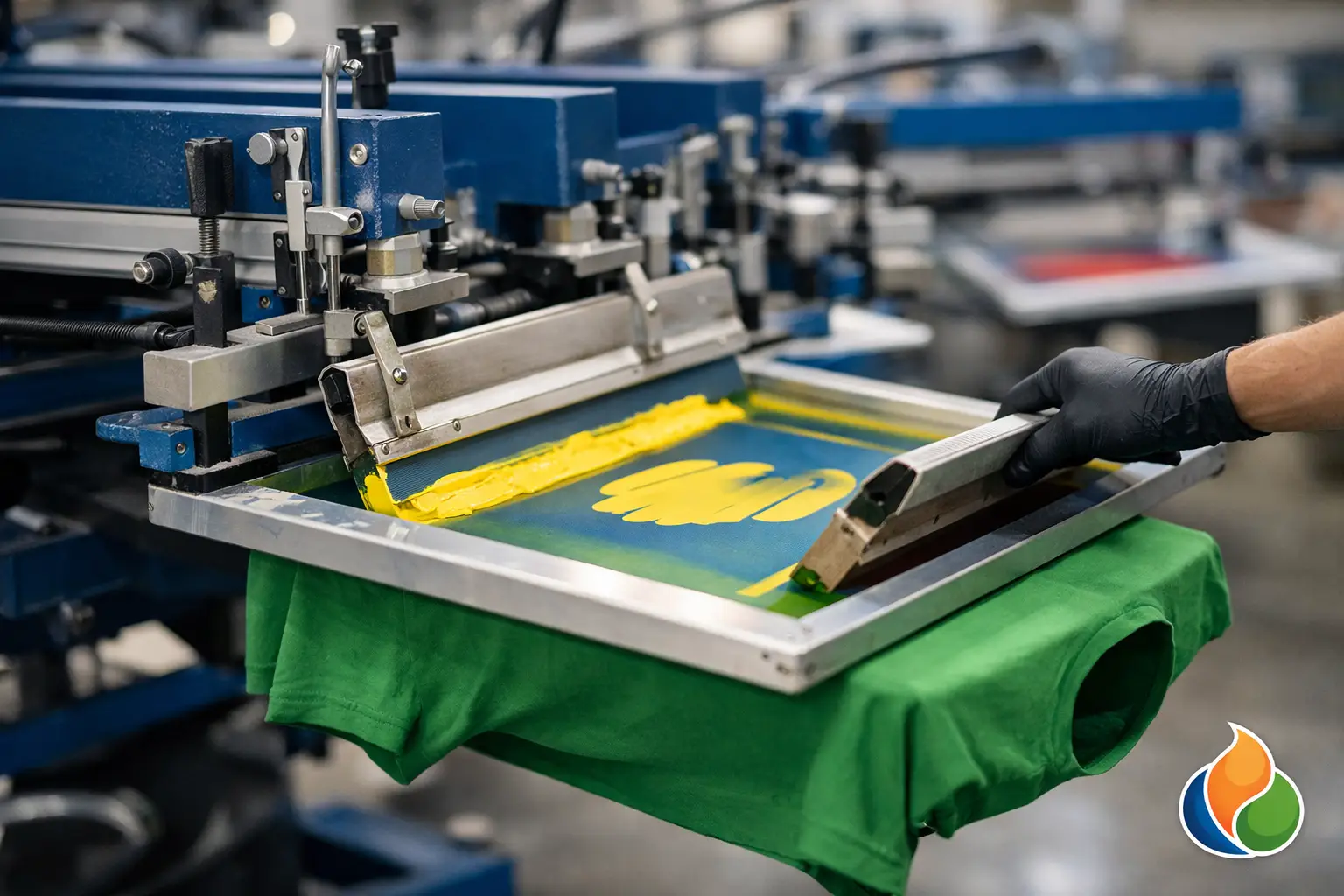
Commercial screen printing is the process of pushing ink through a mesh screen onto a garment or substrate, with a stencil blocking out the areas that should not print. Each ink color in the design usually requires its own screen, which is why this method is especially efficient for larger runs rather than one-off pieces.
In practical terms, that means your logo, slogan, mascot, or event graphic is separated into layers. Those layers are burned onto screens, lined up on a press, and printed one color at a time. The result is a bold, durable print that holds up well on T-shirts, hoodies, workwear, tote bags, and other promotional items.
The word commercial matters here. This is not the same as a hobby setup in a garage printing a handful of shirts. Commercial screen printing is built for production. It focuses on reliable color application, repeat order consistency, and efficient output for businesses, schools, nonprofits, teams, and event organizers.
How Commercial Screen Printing Works
The process starts with artwork. A print-ready design is separated by color so each part of the image can be turned into a screen. If the artwork needs cleanup, adjustment, or resizing for better print quality, that usually happens before production begins.
Once the design is approved, screens are prepared with stencils that define where ink will pass through the mesh. The garment is loaded onto the press, and ink is pushed through each screen in sequence. After printing, the ink is cured with heat so it bonds properly to the fabric.
That sounds simple on the surface, but good commercial printing depends on setup accuracy. Screen tension, registration, ink choice, garment type, and curing temperature all affect the final result. That is why experienced production matters. A clean print is not just about the artwork. It is also about how the job is set up and run.
Why Businesses Use It
Commercial screen printing remains popular because it solves a very specific business need: producing branded apparel at scale without making each piece too expensive.
Once setup is complete, the per-shirt cost usually becomes more efficient as quantities go up. That makes it a strong fit for company shirts, event apparel, school spirit wear, volunteer shirts, staff uniforms, and promotional giveaways. If 50, 100, or 500 pieces all need the same logo in the same place, screen printing is often the most practical route.
It also delivers a look people recognize. Screen printed designs tend to have solid color coverage and a crisp, professional appearance. For logos and branding, that consistency matters. You want the shirts your team wears at a trade show or community event to look intentional, not improvised.
Durability is another reason buyers choose it. A properly printed and cured design can handle repeated wear and washing better than many lower-cost alternatives. That matters for workwear, team apparel, and any item expected to stay in circulation for a while.
What Types of Designs Work Best?
Commercial screen printing works best on designs with clean shapes, readable text, and a limited number of colors. That does not mean the art has to be plain. It means the design should suit the process.
Bold logos, chest prints, back graphics, school names, event branding, and simple promotional artwork usually translate well. Spot-color designs are especially effective because each color can be printed with strong opacity and sharp edges.
Where it gets more complicated is with highly detailed artwork, gradients, and photo-style images. Those can sometimes be screen printed, but they may require specialty techniques, more setup, or art adjustments. At that point, another decoration method such as DTG or DTF may make more sense depending on the garment, quantity, and budget.
That is one of the biggest misconceptions buyers have. There is no single best print method for every project. Commercial screen printing is excellent, but it is not automatic. The right method depends on the job.
When Commercial Screen Printing Makes the Most Sense
If you are ordering apparel for a larger group and the design is fairly consistent across all pieces, screen printing is usually a strong candidate. It is especially useful when you need the same branding repeated across adult shirts, youth shirts, hoodies, or uniforms for a coordinated look.
It also makes sense when your artwork uses a few solid colors and you want a dependable finish that looks polished across the full run. Many businesses prefer it for staff apparel because the prints feel established and professional rather than temporary.
For campaigns and events, it can be an efficient choice because it balances visibility and cost. A well-printed shirt becomes a walking advertisement long after the event ends. That gives the order value beyond the original use date.
When Another Method May Be Better
There are cases where commercial screen printing is not the best fit. If you need many different names or numbers, highly detailed full-color artwork, or a very small run with a lot of design variation, the setup involved in screen printing may not be the most efficient option.
That is where methods like DTG, DTF, or embroidery come into the conversation. DTG can work well for detailed artwork on cotton garments. DTF can be useful for flexible application across different garment types. Embroidery is often the better call when you want a stitched, elevated look for polos, hats, and jackets.
For buyers, the real goal is not choosing the most popular decoration method. It is choosing the method that fits the job. A provider that offers multiple options can help you compare those trade-offs instead of forcing every order into one process.
Common Factors That Affect Cost
The biggest pricing factors in commercial screen printing are quantity, number of print locations, number of ink colors, garment type, and artwork complexity. A one-color front print on 100 basic tees is a very different production job than a six-color front and back print on mixed apparel styles.
Setup plays a major role, so larger runs tend to create better value per piece. That is why screen printing is often associated with bulk apparel orders. The more units you print with the same setup, the more cost-effective the project can become.
Garment choice also matters. Standard cotton tees print differently than performance fabrics, fleece, or specialty materials. The right blank product affects both appearance and budget, so it helps to think about end use before picking the cheapest option on paper.
Quality Depends on More Than Ink
A lot of buyers assume screen printing quality comes down to whether the print looks good on day one. That is only part of it. Real quality shows up in consistency from piece to piece, correct placement, smooth curing, and how well the print holds after repeated use.
It also shows up in pre-production decision-making. The right ink for the garment, proper artwork prep, and realistic expectations about color on different fabrics all matter. White ink on a black hoodie, for example, behaves differently than navy ink on a light gray tee.
That is why commercial screen printing works best when the production team is thinking beyond the press itself. The goal is not just to get ink onto fabric. The goal is to deliver branded apparel people will actually wear.
What Buyers Should Ask Before Ordering
Before placing an order, it helps to think through how the apparel will be used. Is this for a one-day event, an employee uniform program, a fundraiser, or a long-term marketing effort? Will the garments be worn heavily, handed out once, or resold? Those answers affect the best decoration method and product choice.
You should also be clear about the artwork, garment styles, target quantity, and deadline. The more defined the project is, the easier it is to match it with the right production approach. If there is flexibility in the design, that can also help improve value.
For organizations in the greater Salt Lake City area, Affordable-Printing typically sees the strongest results when buyers approach apparel as a visibility tool, not just an item to check off a list. That mindset usually leads to better product choices and better outcomes.
Commercial screen printing is not complicated once you understand what it is built to do. It is a dependable, scalable way to put your brand on apparel when consistency, durability, and cost control matter. If your goal is to get your message out clearly and put it on products people will actually use, it remains one of the smartest tools available.
Ready to start your order?
GET A FREE QUOTE