_1782777776334-CjnZ693B.png)
May 31, 2026
How to Choose Embroidered Work Shirts
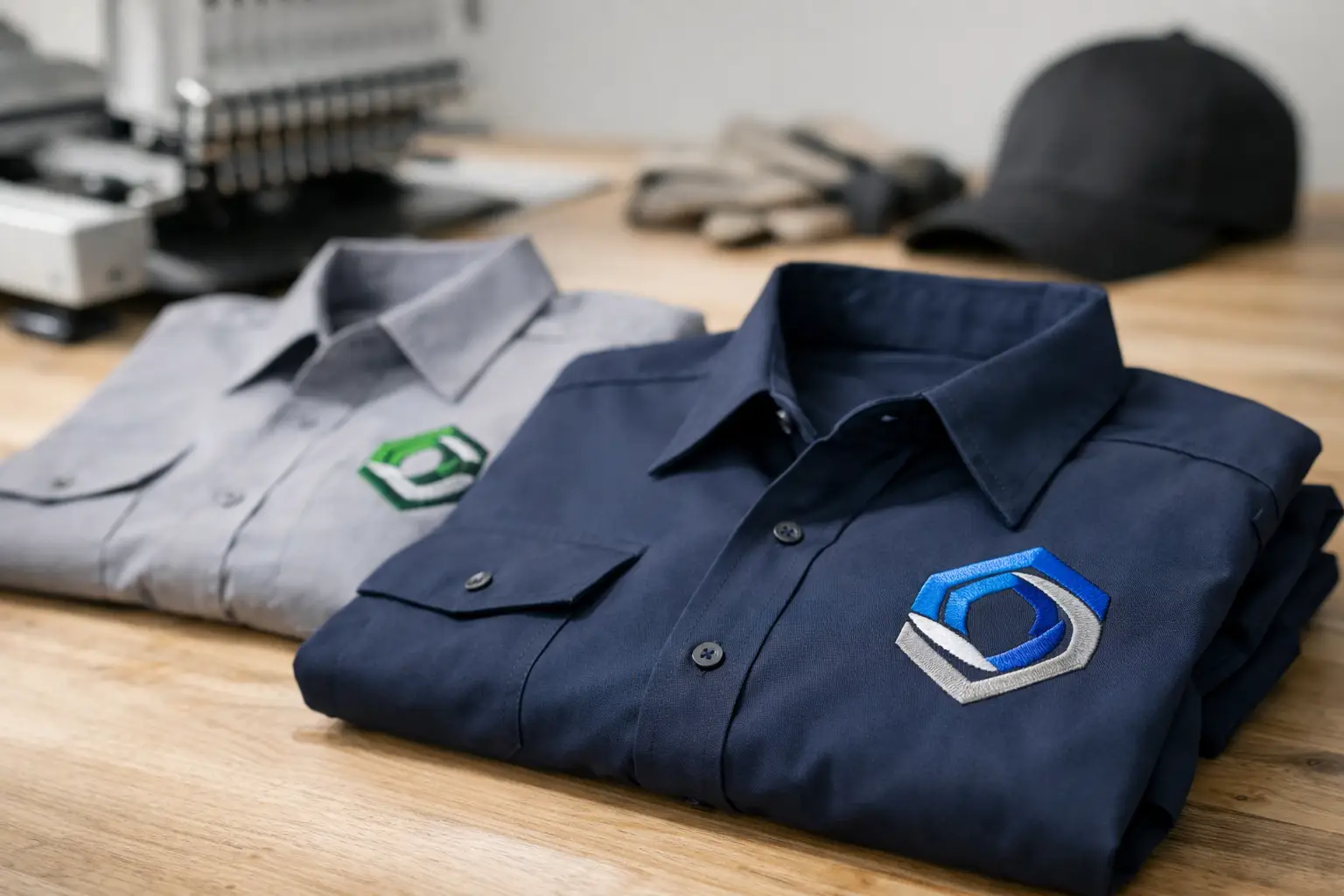
A work shirt has to do more than carry a logo. For your team, it needs to hold up on the job, look consistent across departments, and represent your company well when employees are on site, on the road, or meeting customers. That is why embroidered work shirts stay popular with businesses across Salt Lake City and the Wasatch Front. They look polished, wear well, and give your brand a more permanent, professional feel than many other decoration methods.
If you are ordering for a company, the real question is not whether embroidery looks good. It usually does. The better question is whether the shirt, logo placement, fabric, and budget all make sense together. That is where many apparel orders go sideways. A nice logo stitched onto the wrong garment still ends up being the wrong order.
Why embroidered work shirts make sense for business uniforms
Embroidery works especially well when your company needs a clean, durable mark that can handle repeat wear. For office staff, service teams, drivers, sales reps, warehouse supervisors, and event crews, embroidered work shirts tend to signal credibility right away. A stitched logo on a polo, button-down, or work shirt usually reads as more established than a printed chest graphic.
There is also a practical reason businesses choose embroidery. Thread holds up well over time. When shirts are washed often, packed in trucks, or worn through long shifts, embroidery generally keeps its shape and color better than some print applications on the same garment category. That does not mean embroidery is always the best answer, but it is a strong option when longevity matters.
For many companies, embroidered uniforms also help with internal consistency. If your front office, field team, and managers all need branded apparel, embroidery can give different garments a unified look even if the shirt styles vary.
Start with the job, not the logo
The biggest mistake business buyers make is choosing apparel based only on appearance. Your team has to wear these shirts for real work. Before you approve any style, think about where and how the shirts will be used.
If your employees work indoors in customer-facing roles, a lightweight polo or button-down may be the right fit. If they are in construction supply, facilities, delivery, manufacturing, or field service, you may need a sturdier work shirt with structure and heavier fabric. If your team moves between office and job site, you may need something that feels polished but still holds up to daily wear.
This is also where fabric matters. A soft performance polo can be great for comfort, but some lightweight fabrics behave differently under embroidery than a more substantial cotton blend. Heavier materials often provide a stable surface for stitching, while thinner garments can pucker if the logo is too dense or too large. Good embroidery is not just about the machine. It starts with choosing the right blank.
Choosing the right shirt style for embroidered work shirts
There is no single best shirt for every company. The right option depends on your brand image, your work environment, and your budget.
Polos are the most common choice because they sit in the middle. They are more professional than a T-shirt, more relaxed than a woven dress shirt, and flexible across departments. For offices, property management teams, schools, and corporate event staff, polos are often the easiest call.
Button-down work shirts create a more traditional uniform look. They make sense for companies that want a sharper presentation or need a shirt that feels more substantial. They also pair well with left-chest embroidery because the logo placement looks natural and balanced.
Industrial-style work shirts are built for harder use. If your employees work in physical roles, these shirts can make more sense than trying to force a lightweight corporate polo into a demanding environment. They usually cost more than entry-level options, but they can save money if they last longer and employees actually wear them.
The fit matters too. A shirt your team dislikes will spend more time in lockers and back seats than on the job. For company-wide orders, it helps to choose styles with broad size availability and a fit that works for different body types.
Logo size, placement, and stitch quality
Most businesses do best with a simple left-chest logo. It is clean, readable, and appropriate for almost every type of embroidered work shirt. Going larger is possible, but bigger embroidery is not always better. A large stitched design adds more thread, more weight, and more cost. On some garments, it can also feel stiff.
This is where design trade-offs matter. Fine details, tiny text, and gradients that look good on a screen may not translate well to thread. Embroidery has physical limits. If your logo includes small lines or very tight lettering, it may need to be adjusted so it sews cleanly. That is normal. Good digitizing and thread matching make a major difference in the final result.
For business buyers, consistency matters as much as appearance. If you are outfitting a team, you want every shirt to look like part of the same program. That means the same placement, scale, and thread colors from one garment to the next.
Budget matters, but so does replacement cost
Price is always part of the conversation, especially when you are ordering for 12 employees or 120. But the cheapest shirt is not always the lowest-cost decision. If the fabric wears out quickly, the collar loses shape, or the shirt becomes uncomfortable after a few washes, you may be reordering sooner than planned.
A better way to think about cost is cost over time. If a slightly better garment holds up longer, keeps your team looking presentable, and reduces replacement orders, it may be the smarter buy. On the other hand, if you need shirts for a short-term promotion, seasonal event, or temporary staff, a more basic option may be perfectly reasonable.
It depends on the use case. Daily uniforms deserve a different conversation than event apparel.
When embroidery is the right method and when it is not
Embroidery is excellent for logos, names, and simple branding on polos, jackets, hats, and woven shirts. It gives a premium look and strong durability. But it is not ideal for every design.
If your artwork is large, full color, or highly detailed, another decoration method may be a better fit. Screen printing, DTF, and DTG each have their place depending on the garment and graphic. For example, a large back design for an event crew may be better printed, while the front chest logo stays embroidered on a polo or outerwear.
That is why it helps to work with a team that can look at the whole project instead of pushing one method for every job. Sometimes the best answer is embroidery. Sometimes it is a mix.
Ordering for your team without making it complicated
For most business buyers, the challenge is not choosing between ten shades of blue. It is managing the order without wasting time. You need clear pricing, help with garment selection, confidence in the artwork, and a realistic timeline.
Our team handles this every day for companies in South Jordan, Salt Lake City, and across the Wasatch Front. We typically recommend starting with a few practical questions: who will wear the shirts, how often, in what environment, and what impression should they give customers? Once those answers are clear, the garment and decoration choices get much easier.
We also encourage businesses to plan around actual production timing. Our minimum for decorated apparel is 12 pieces, and standard turnaround is 12 business days from artwork approval, although we often finish sooner. If your deadline is tight, it is worth discussing that up front. Rush orders are available when the schedule allows.
Another detail that helps is letting one provider manage both garments and decoration. Most clients find it more cost effective when we supply the shirts rather than trying to source blanks from multiple places. We can also work with customer-supplied garments if needed. Either way, getting the embroidery right starts with matching the logo to the shirt, not treating those as separate decisions.
What good embroidered work shirts should accomplish
At the end of the day, embroidered work shirts should make your company easier to recognize and your team easier to trust. They should fit the work, hold up under normal use, and make employees feel like they are part of a professional operation. If the shirts look sharp on day one but fail after repeated wear, that is not a win. If they are durable but uncomfortable enough that your staff avoids them, that is not a win either.
The best orders find the middle ground. Good garments. Clean embroidery. Realistic budgets. A process that does not create extra work for your office manager, HR team, or operations staff.
If your company is planning embroidered work shirts for uniforms, events, or staff apparel, we can help you sort through the options and get a clear quote. Call (801) 260-0606 or visit affordable-printing.com/request-a-quote/ to get a free quote.
Ready to start your order?
GET A FREE QUOTE