_1782777776334-CjnZ693B.png)
May 3, 2026
Explain Screen Printing for Business Buyers
If you need to explain screen printing to a team member, client, or event committee, start with this: it is a method of printing ink onto apparel or other products by pushing ink through a mesh screen, one color at a time, in specific areas of the design. It remains one of the most common decoration methods for custom T-shirts, hoodies, staff apparel, school gear, and promotional wear because it balances durability, visual impact, and cost well on many orders.
For organizations ordering branded apparel, that matters more than the technical process itself. The real question is usually not what screen printing is in theory. It is whether it is the right choice for your logo, quantity, timeline, and budget.
Explain screen printing in simple terms
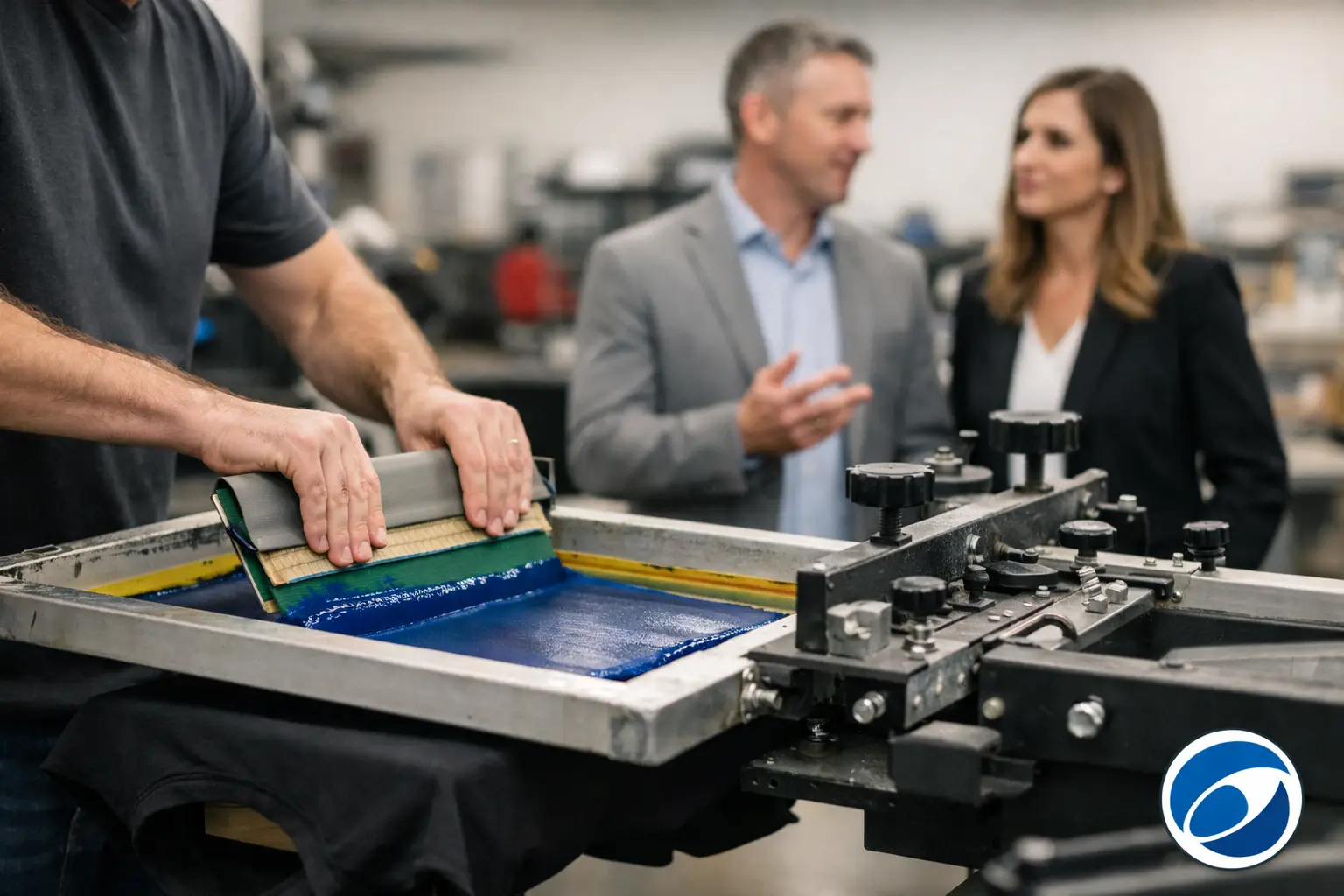
Think of screen printing as a stencil-based process. A screen is prepared for each ink color in the design. Ink is then pressed through that screen onto the garment in the exact areas where that color should appear. If your design has one color, it uses one screen. If it has three colors, it typically uses three screens.
That setup is why screen printing works especially well for larger runs and repeat orders. Once the screens are created and the press is set up, production moves efficiently. For a business ordering uniforms, a school ordering spirit wear, or an event organizer outfitting volunteers, that efficiency can translate into a better per-piece cost than some other decoration methods.
The finished print usually has strong color, good opacity, and long wear when the artwork and garment are a good fit for the process. That is one reason screen printing has stayed relevant even as newer apparel decoration methods have become more available.
How screen printing works
The screen printing process is fairly straightforward, but there are several production steps behind a clean final result. First, the artwork is separated by color. Each color needs its own screen, so the design has to be prepared in a way the press can reproduce accurately.
Next, screens are coated and exposed so the image area remains open while the rest of the mesh blocks ink. Once those screens are ready, they are loaded onto the press and aligned carefully. Registration matters here. If the colors are not lined up correctly, the final print can look blurry or off-center.
Then the garment is placed on the press, and ink is pushed through each screen in sequence. After printing, the ink is cured with heat so it bonds properly to the fabric. That curing step is a big part of durability. A print that looks good when it leaves the press still has to hold up through wear and washing.
For buyers, the takeaway is simple: screen printing is not just putting ink on a shirt. It is a setup-driven production method designed to create consistent results across multiple pieces.
Why one color at a time matters
This is the part that often affects pricing and design decisions. Because each color usually requires its own screen and setup, a one-color logo is more economical to produce than a six-color illustration. That does not mean multi-color designs are a bad idea. It just means complexity changes the production approach.
If you are ordering for a fundraiser, employee apparel program, or community event, keeping the design focused can often stretch the budget further without hurting the visual impact.
When screen printing makes the most sense
Screen printing is often the best fit when you need a solid number of shirts or garments with the same design. It is a strong option for company uniforms, school clubs, sports teams, nonprofits, church groups, trade show apparel, and event merchandise.
It also performs well when your design uses bold artwork, spot colors, and clean branding elements such as logos, slogans, and simple graphics. If your goal is consistent branded visibility across a group, screen printing is usually worth considering first.
This is especially true when you want prints that look substantial and hold up over time. For work shirts, promotional tees, and team apparel that will be worn repeatedly, durability carries real value.
Best use cases for business and event apparel
A business may use screen printing for staff shirts, customer giveaway apparel, or branded merchandise sold at events. A school may use it for spirit shirts, club apparel, or field day shirts. A nonprofit may choose it for awareness walks or volunteer identification. In each case, the buyer usually wants a method that keeps unit cost manageable while still producing a clear, dependable print.
That is where screen printing continues to stand out.
Where screen printing has trade-offs
No decoration method is perfect for every order. Screen printing has strengths, but it also has limits.
The main trade-off is setup. Because screens have to be created for each color, very small runs can be less efficient than other methods. If you only need a handful of pieces or every item has different artwork, another decoration option may make more practical sense.
Highly detailed photographic images can also be more complicated. Screen printing can reproduce detailed art, but the process works best when the artwork is designed with the method in mind. Fine gradients, dozens of color shifts, and image-heavy compositions may be better suited to other print technologies depending on the garment and quantity.
Garment color matters too. Printing light ink on a dark shirt may require an underbase and additional production steps. That is normal, but it can affect cost and feel. None of this makes screen printing a poor choice. It simply means the best results come from matching the artwork to the process rather than forcing the process to fit every design.
Screen printing vs. other decoration methods
Buyers often compare screen printing with DTG, DTF, and embroidery. The right choice depends on the job.
Screen printing is usually strongest when you need consistent prints on a larger quantity of garments and the design is not overly complex. It is often the value choice for bulk apparel with logos or event graphics.
DTG, or direct-to-garment printing, can be useful for artwork with more detail or color variation, especially on smaller quantities. DTF, or direct-to-film, offers flexibility for many types of designs and can work well when jobs need more variation. Embroidery is a different category altogether, typically chosen for polos, jackets, hats, and items where a stitched logo creates the right look.
For many organizations, the decision is not about which method is best overall. It is about which method is best for that specific use. A volunteer T-shirt order may point toward screen printing, while branded quarter-zips for management may be a better embroidery project.
What affects screen printing cost
If you are budgeting a custom apparel order, several factors shape the final price. Color count is one of the biggest. More colors usually mean more screens and more setup.
Print location also matters. A left chest print is different from a full front print, and adding a back print or sleeve print increases production steps. Garment type affects cost as well. Basic cotton tees, premium blends, hoodies, and performance wear all carry different price points and may print differently.
Order size often changes the economics in your favor. Because setup is spread across more garments, the cost per piece usually becomes more attractive as quantity increases. That is one reason screen printing is so common for schools, events, and company apparel programs.
Artwork quality can influence cost too, especially if a logo needs adjustment before it can be printed cleanly. Clear, production-ready art helps keep the process efficient.
How to know if your design is a good fit
A strong screen printing design is usually clean, readable, and intentional. Bold logos, simple graphics, and limited color palettes tend to perform well. That does not mean every design has to be plain. It means the artwork should be built for visibility and production.
If your apparel is meant to identify staff, promote an event, or reinforce your brand in public, clarity often matters more than artistic complexity. A shirt that reads well from a distance usually does its job better than one packed with too much detail.
This is also why business-minded buyers often simplify artwork for apparel even when their full brand standards are more complex. The goal is not to reproduce every possible design element. The goal is to get the message out clearly on the product people will actually wear.
What buyers should ask before ordering
Before placing a screen printing order, it helps to confirm the garment type, quantity, ink colors, print locations, and intended use. A shirt for a one-day event may not need the same garment quality or print approach as a long-term employee uniform program.
It also helps to discuss whether your design should be adjusted for print performance. Small changes can improve readability, reduce unnecessary cost, and create a better result on the actual garment.
For organizations in Salt Lake City and across nearby Utah counties, working with a provider that handles multiple decoration methods can make this easier. If screen printing is the right fit, great. If another method makes more sense for your design or order structure, you can make that decision based on the project rather than guesswork.
The practical way to explain screen printing is this: it is a proven method for putting bold, durable designs on apparel efficiently, especially when you need a consistent look across a group. If your priority is branded visibility with sensible production value, it is still one of the smartest places to start.
Ready to start your order?
GET A FREE QUOTE